


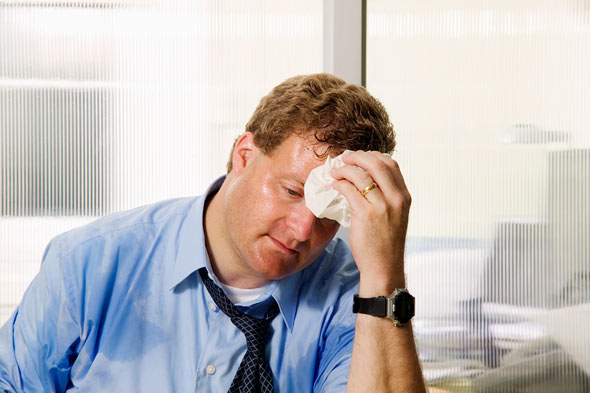
Do you know about hyperhidrosis? Whether it’s hot, you have a strong emotion (anxiety, stress), as soon as you do a simple physical effort, or sometimes even for no reason… Sweat drops on your face, wet your armpits, your back, make your hands wet. You sweat excessively.

Although sweating is normal and essential for the body, excessive sweating (or hyperhidrosis) is rather a condition that affects some people, who have a really hard time living with it. So what is it? Can this condition be treated, and even prevented?
What is hyperhidrosis?
Hyperhidrosis is a scientific term (from the Greek hidrôs meaning sweat) for excessive sweating or excessive sweating. If it’s a fever or hot flash, excessive sweating seems obvious. But when there’s no particular disease or condition behind it, you’ll be more likely to worry about it.
If there is no specific cause for excessive sweating, it is called primary (or essential) hyperhidrosis. This is the most common form. When it is caused by an external condition, hyperhidrosis is called secondary. It is referred to as localized if it is limited to a few parts of the body (hands, feet, face, scalp, underarms, or genital parts). It is generalized if the body as a whole produces too much sweat (often the case for secondary hyperhidrosis).
Although it is not a serious condition, hyperhidrosis affects 1 to 3% of the population (which is rather significant), and for these people it is a disabling disease, about which they often do not like to talk, because although there are ways of controlling this excessive production of sweat, few people dare to consult a doctor.
Transpiration disorders and hyperhidrosis usually begin during puberty, and people with them often experience social embarrassment, so they are reluctant to talk about it or even consult a doctor.
What are the risk factors?
Factors that increase the risk of developing hyperhidrosis include: heredity, obesity or even ethnic origin (those in Southeast Asia are more likely to develop localized hyperhidrosis).
In addition, in people, especially women, the approach of menstruation or the onsetmenopauseThere’s also stress, nervousness, or any other strong emotion you feel.
It should be noted that hyperhidrosis occurs mainly in people prone to redness (a sign of social discomfort) or heart palpitations, and occurs exclusively during the day (never at night).
What’s causing this excessive sweating?
All forms of hyperhidrosis originate from the hyperactivity of the sweat glands, which are distributed over the entire surface of the skin and produce sweat by the millions. When the body temperature rises, during intense physical activity or in hot weather, sweat refreshes the body.
So sweating is a completely normal physiological phenomenon. And it’s a gland in the brain, the hypothalamus, that normally acts to regulate body temperature, so the production of sweat. When the body temperature rises, the hypothalamus dilates the arteries and increases the production of sweat. It’s the evaporation of sweat produced on the skin that cools the body. On average, an adult produces 1 liter of sweat a day.
When hyperhidrosis is primary, the hyperactivity of the sweat glands may be due to dysfunction of the glands themselves or from the control centre, the hypothalamus. When it is secondary, hyperhidrosis is the symptom of another pathology.
Depending on its extent, hyperhidrosis can be difficult to experience by the affected person. It can be the cause of a social phobia in this person (because of the discomfort caused) and the discomfort triggers more sweating.
The most important physiological consequence of this condition is dehydration; in addition, sweating makes the skin more sensitive to other conditions (warts, hot flushes, athlete’s foot).

How to treat hyperhidrosis?
If it is secondary, treating the underlying disorder will relieve the symptoms.
If hyperhidrosis is primary, treatment can be done in several ways: using powerful antiperspirants (available without a prescription), taking medicines by mouth (prescription only), ionophoresis (treatment using an electric current) or surgery (removal of part of the sweat glands).
How do we stop it ?
This is perhaps the most important point: it is often enough to take a few steps to prevent excessive sweating and its consequences:
- le wearing appropriate clothing, especially in natural materials (cotton, linen), to allow the skin to breathe.
- have an adequate diet, avoiding foods and substances (caffeine, alcohol, tobacco) that tend to stimulate sweat production.
- and to reduce daily discomfort, make sure to wash daily, especially areas prone to hypertranspiration, to eliminate bacteria and thus avoid the appearance of nauseating body odors (and fungus as well).
- Other measures: hair removal, use of an antiperspirant, etc.