

June 2025
The survey conducted by Discurv for XloveCam primarily aimed to understand the perceptions and opinions of Spaniards aged 18 and over regarding the attractiveness of various celebrities. The results show strong participation, balanced demographically and geographically, with an even gender distribution and a majority of respondents in employment.
From a demographic perspective, most participants are aged 35–49, followed by those aged 18–34, with a strong concentration in the regions of Andalusia, Catalonia, and Madrid. There is also a range of employment situations, with full-time employment predominating.
In terms of celebrity attractiveness, Carlos Sainz Jr. and Rafael Nadal are perceived as the most attractive male athletes, while Alexia Putellas leads among female athletes. In film, Antonio Banderas and Blanca Suárez stand out among actors and actresses. Pablo Alborán is considered the most attractive male singer, while Aitana leads among female singers.
Interestingly, a significant number of respondents did not find any of the proposed celebrities particularly attractive, highlighting the diversity of opinions and tastes among the Spanish population. Respect for privacy also appears to have been a key factor in encouraging participation in the survey.
In this study on perceptions of male athletes’ attractiveness, Carlos Sainz Jr. and Rafael Nadal are tied for first place. They are followed by Sergio Ramos and the option “none of these celebrities.” This shows a shared preference for figures from motorsport and tennis.

This ranking highlights male attractiveness strongly centered around iconic sports figures, combining performance, longevity, and media exposure.
Carlos Sainz Jr. (F1) and Rafael Nadal (tennis) are tied for first place with 15% each. They embody a form of sex appeal based on mastery, discipline, and elegance, supported by a very strong international image.
Sergio Ramos (football) follows closely with 14%, confirming that football remains a powerful driver of attractiveness, particularly thanks to charisma, leadership, and media visibility.
Gavi (12%) and Fernando Alonso (11%) illustrate two different dynamics:
Gavi represents a younger, more spontaneous and generational form of sex appeal,
while Alonso embodies experienced and respected charisma that continues to appeal over time.
After this top five, there is a sharp drop:
Renowned athletes such as Ricky Rubio, Pau Gasol, and David Ferrer reach no more than 4%, despite their prestigious careers.
More technical or less mainstream figures (Marc Gasol, Miguel Indurain, Alejandro Valverde, Jesús Ángel García) rank between 1% and 2%.

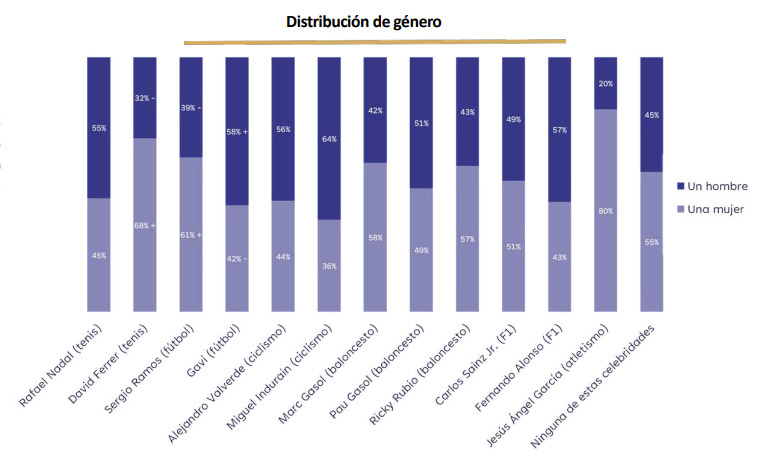
Respondents aged 18–34 prefer Gavi and Carlos Sainz Jr., while those over 50 favor Nadal, Ramos, or Alonso. Most votes come from women, except for Jesús Ángel García, who is supported mainly by men. Younger respondents are attracted to more recent media figures, while older respondents remain loyal to established icons.

Alexia Putellas (football) clearly takes first place with 20% of responses. She embodies modern attractiveness, combining charisma, leadership, and sporting success that extends well beyond the pitch.
She is followed by Paula Badosa (tennis) with 17%, confirming the central role of women’s tennis in perceptions of sex appeal, often associated with elegance and individual performance.
Mireia Belmonte (swimming) completes the podium with 11%, showing that a less widely covered sport can still appeal when the athlete has a strong and recognizable public image.
Behind these leading figures:
Garbiñe Muguruza (10%) and Jennifer Hermoso (9%) remain highly prominent, supported by their international recognition and sporting careers.
Sara Hurtado (7%) stands out in figure skating, a sport where aesthetics and physical expression strongly influence perceived attractiveness.
By contrast, athletes from less widely covered sports rank toward the bottom:
Irene Paredes (4%) and Jennifer Pareja (3%) maintain more limited visibility.
Basketball players and cyclists such as Alba Torrens, Laia Palau, Sheyla Gutiérrez, and Mavi García receive only 1–2%, despite major sporting careers.

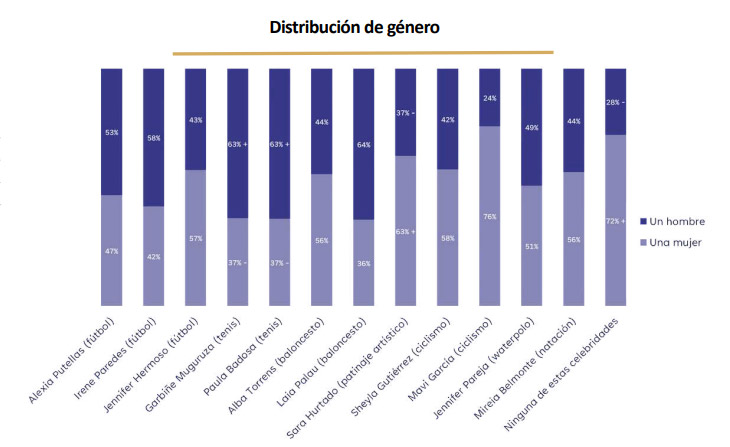
Preferences for female athletes vary by age and gender: respondents aged 18–34 prefer Alba Torrens, Paula Badosa, and Jennifer Hermoso, while those over 50 more frequently choose Mireia Belmonte or Sheyla Gutiérrez. Most votes come from women, except for Belmonte and García, who receive more votes from men.

This chart shows a very clear hierarchy, dominated by actors with long careers and firmly established public images.
Antonio Banderas leads by a wide margin with 21% of responses. His attractiveness is based on a combination of Latin charisma, maturity, and international appeal that continues to resonate across generations.
Just behind him, Miguel Ángel Silvestre receives 19%, confirming the impact of actors from highly visible TV series, where repeated exposure strengthens attachment and desire.
A first significant drop appears with Hugo Silva (13%), whose more rugged and approachable image appeals to a loyal but smaller audience.
From there, scores decline quickly:
Álex González ranks at 8%,
while Javier Bardem, despite being a global star, reaches only 6%, showing that international fame does not automatically translate into being perceived as “sexy.”
The rest of the ranking is highly fragmented:
Miguel Ángel Muñoz and Arón Piper (5% each) benefit primarily from generational popularity.
Miguel Bernardeau and Paco León follow with 4%, representing more unconventional or less universally appealing profiles.
Finally, Fernando Rey, Gabriel Guevara, and Raúl Arévalo round out the ranking with 1–3%, reflecting a more niche form of attractiveness.
Key takeaway: among male actors, sex appeal is strongly associated with career longevity and a public image built over time. Iconic figures clearly dominate, while newer or more discreet talents struggle to compete, even when they are critically recognized.

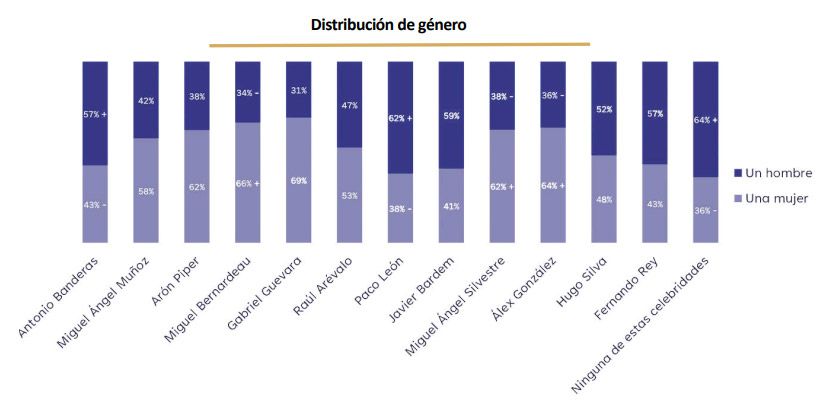
Generational differences influence preferences: Banderas and Fernando Rey are favored by respondents over 50, while Arón Piper and Miguel Bernardeau appeal to those aged 18–34. Votes come mainly from women, except for Fernando Rey and Banderas, who are more appreciated by men.

This ranking highlights female attractiveness largely dominated by prominent figures in Spanish cinema, where screen presence and personality clearly outweigh age or current media exposure.
Blanca Suárez takes first place with 20% of the votes. Her success is based on an image that is modern, elegant, and approachable, reinforced by popular roles and strong media visibility.
Just behind her, Penélope Cruz receives 17%, confirming that her international aura and iconic status remain extremely powerful, even when competing with a new generation of actresses.
Úrsula Corberó ranks third with 15%, embodying this new wave. Her high score demonstrates the impact of memorable characters and a bolder image, particularly among younger audiences.
A first drop then appears with:
Ester Expósito (10%), whose attractiveness remains strong but is more concentrated among a specific generation,
and Maribel Verdú (8%), a more mature figure appreciated for her elegance and enduring charisma.
The second half of the ranking is more fragmented:
Mónica Cruz and Najwa Nimri each reach 5%,
while Nicole Wallace and Sara Montiel follow with 4%, representing very different profiles with more targeted recognition.
Finally, Elena Anaya (3%), Mina El Hammani (2%), and Carmen Maura (1%) round out the ranking, illustrating attractiveness that is more closely associated with artistic recognition than with being perceived as strictly “sexy.”
Key takeaway: among Spanish actresses, sex appeal relies on a balance between fame, the strength of their roles, and public personality. Established icons coexist with younger figures, but those who combine visibility with compelling screen charisma clearly dominate.

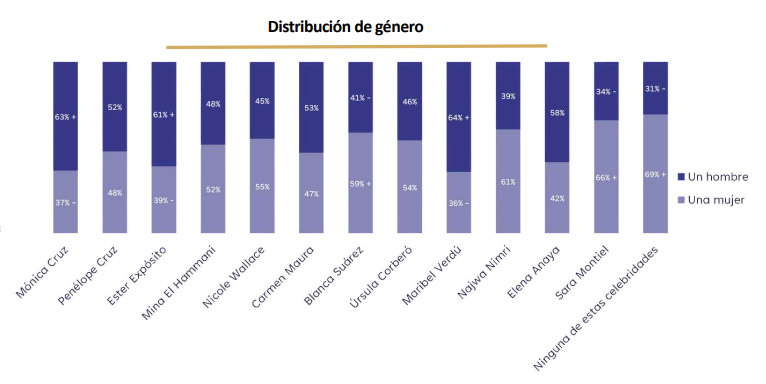
Preferences vary according to age and gender: respondents aged 18–34 prefer Mónica Cruz (16%) and Ester Expósito (25%), while those aged 65+ favor Sara Montiel (40%) or Carmen Maura (31%). Men vote more frequently for Mónica Cruz (63%) and Úrsula Corberó (64%), while Penélope Cruz and Nicole Wallace attract a more balanced audience.

This ranking reveals male attractiveness largely dominated by established public figures, where style, presence, and media visibility play a central role.
Jon Kortajarena clearly takes first place with 16% of the votes. His image as an international model, combined with confident elegance and a regular presence in fashion and film, makes him a clear benchmark for male sex appeal.
Behind him, Jesús Vázquez receives 13%, confirming that maturity and television charisma remain highly attractive. His long career and well-established public personality reinforce this lasting appeal.
Andrés Velencoso, with 12%, completes the top three. Like Kortajarena, he benefits from a strong fashion profile, combining physical attractiveness with a sophisticated and international image.
A second group then emerges with closer scores:
David Broncano and Montoya each receive 6%, illustrating attractiveness linked more closely to personality and humor than to conventional looks.
Jordi Cruz Mas and David Muñoz follow with 5%, supported by their media prominence and image of success.
Finally, the bottom of the ranking includes a wide variety of profiles:
Santi Millán and Joaquín Reyes (4% each),
Carlos Latre, TheGrefg, and Álvaro Mel (3%), whose attractiveness is more closely associated with audience relatability, humor, or digital influence.
Overall, this chart shows that male sex appeal is not limited to youth or online influence. The most popular profiles combine elegance, media exposure, and a strong identity, while figures from entertainment or the digital world attract more fragmented support.

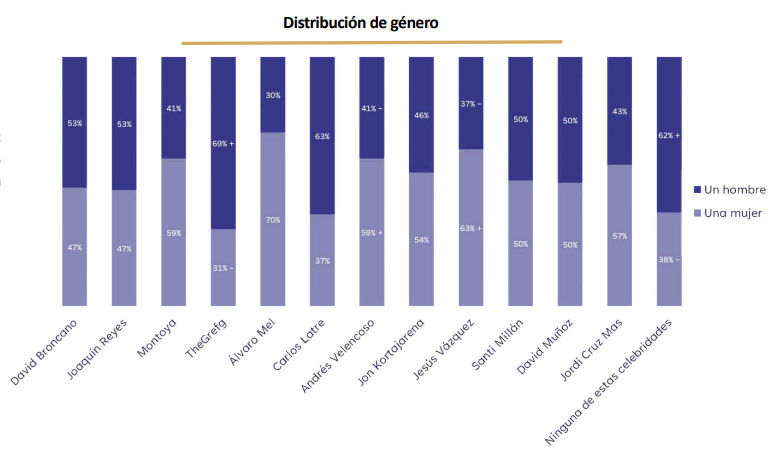
Figures such as TheGrefg (62% among 18–34-year-olds) and Álvaro Mel (38%) appeal to younger audiences, while Carlos Latre and David Muñoz receive more votes from those over 50. TheGrefg, Álvaro Mel, and Moroya appeal mainly to women, unlike Joaquín Reyes and David Broncano, who attract a more mixed audience. Carlos Latre and Andrés Velencoso receive more votes from men.

This chart stands out for its very clear leader. Sara Carbonero ranks well ahead with 30% of the votes, almost twice the score of the runner-up. Her result reflects cross-generational attractiveness, supported by an image that is elegant, approachable, and emotionally engaging, extending well beyond her media fame alone.
In second place, Georgina Rodríguez receives 16%, confirming the appeal of highly publicized figures associated with luxury and glamour. Her highly visual image and strong presence on social media play a key role here.
Patricia Conde completes the podium with 12%, illustrating a more “feel-good” form of attractiveness driven by likability, humor, and a long-standing television presence.
Behind this trio, scores fall quickly:
Susanna Griso receives 7%, followed by Dulceida (Aida Domènech) and Esther Cañadas with 6% each. These profiles show that digital influence or model status continue to appeal, although in a more fragmented way.
Silvia Abril (4%), followed by Eugenia Silva and Ana Blanco (3%), embody a form of attractiveness linked more closely to personality, credibility, and media longevity than to pure glamour.
Finally, the bottom of the ranking (Martina D’Antiochia, Blanca Padilla, Pepa Rus, between 1% and 2%) highlights a clear dispersion of votes, with no dominant figure beyond the top three.

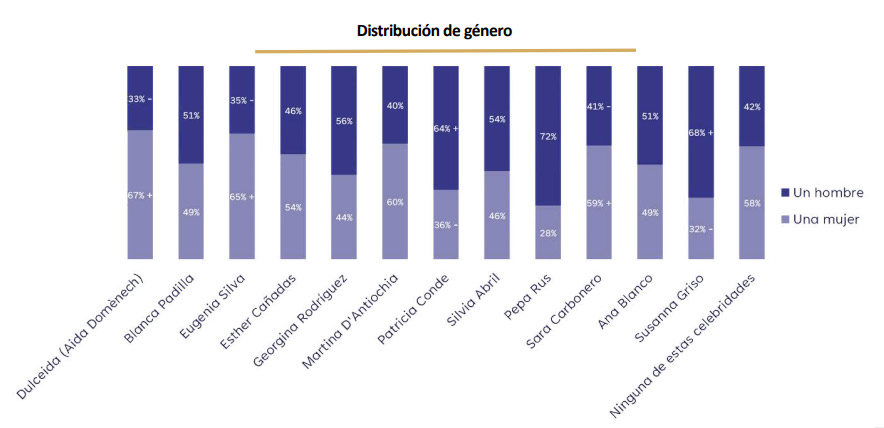
Dulceida is highly popular among 18–34-year-olds (44%) and women (67%), while Blanca Padilla appeals more to the 35–49 age group. Peppa Rus and Sara Carbonero attract a predominantly male audience (72% and 68%), unlike Ana Blanco or Patricia Conde, whose audiences are more balanced. Susanna Griso and Silvia Abril are particularly popular among those aged 50+.

This ranking highlights attractiveness strongly associated with artistic emotion and perceived closeness to the audience. Pablo Alborán clearly takes first place with 19% of the votes, confirming his status as a sensitive and charismatic figure. His image as an authentic artist, combined with the strong emotional quality of his songs, appears to play a decisive role.
Behind him, Enrique Iglesias and Manuel Carrasco share second place with 14% each. Enrique Iglesias benefits from international sex appeal and a strong Latin image, while Manuel Carrasco appeals more through his simplicity and association with values perceived as sincere.
David Bisbal, with 11%, remains a firm favorite: his stage energy and established fame continue to attract support. Alejandro Sanz follows closely with 10%, embodying a more mature and emotional form of appeal rooted in the longevity of his career.
Below the top five, attractiveness becomes more fragmented:
Melendi reaches 6%,
Julio Iglesias retains 4%, showing that his long-standing charisma continues to resonate over time,
while C. Tangana and Natos y Waor each receive 3%, representing a more alternative and generational form of appeal.
Finally, Morad (2%) and Íñigo Quintero (0%) round out the ranking, reflecting more niche or still-emerging recognition.

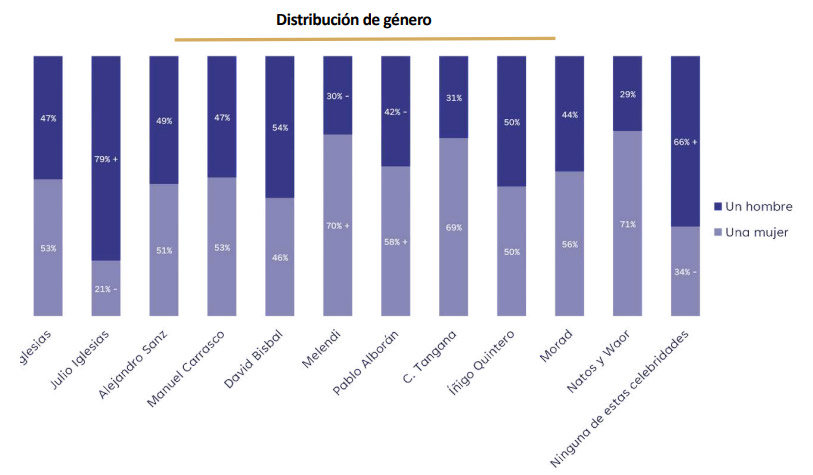
Julio Iglesias and Alejandro Sanz appeal more strongly to those aged 50+, while Alborán and David Bisbal are particularly popular among women (70% and 58%). By contrast, Morad and Íñigo Quintero attract younger audiences (46% and 49%) and men.

The results highlight the clear dominance of artists most closely associated with contemporary pop. Aitana leads by a wide margin with 25% of the votes, confirming strong appeal linked to her youth, media visibility, and highly contemporary image.
She is followed by Rosalía with 14%, supported by her distinctive artistic charisma and strong identity, both musically and aesthetically. Ana Mena, with 13%, completes the top three, appealing through a dynamic and international image.
Further behind, Marta Sánchez reaches 10%, representing a more established form of appeal, while Bad Gyal (7%) attracts a more niche audience drawn to her provocative style.
The lower part of the ranking shows more dispersed scores:
Vanesa Martín (5%),
Pastora Soler and Rocío Jurado (4% each),
Natalia Jiménez and Amaia Romero (3%),
Niña Pastori (2%) and Isabel Pantoja (1%).
This chart therefore illustrates attractiveness largely concentrated around younger female pop figures, leaving relatively little room for more traditional or generation-specific profiles.

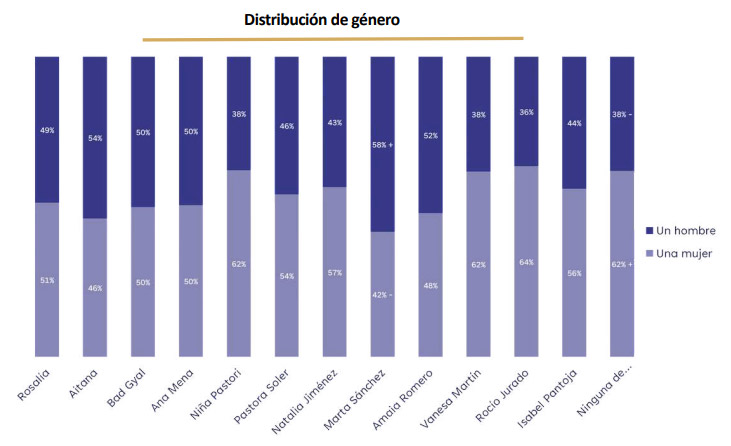
Rosalía, Aitana, and Bad Gyal appeal to 18–34-year-olds and predominantly female audiences (up to 64%). Rocío Jurado and Isabel Pantoja are more popular among those aged 50+.
The study reveals preferences clearly influenced by age, gender, and media visibility. Responses show considerable diversity in generational tastes and clear segmentation in preferred personalities.
Influence of age
Respondents aged 18–34 prefer figures associated with pop culture, social media, or contemporary sport:
Those aged 50+ remain attached to classic figures:
Generational effect
Influence of gender
Most votes for male celebrities come from women, particularly for romantic or seductive profiles:
Some female celebrities attract more men:
Some celebrities appeal to a more balanced audience:
A celebrity’s attractiveness depends mainly on:
This portrait reflects a Spain rich in generational diversity, where tastes vary between modernity and cultural tradition.
A study conducted by:
Audrey Mandefield, Senior Account Executive
Pauline Poché, Head of Research
TO BE CITED AS FOLLOWS:
"Discurv study for XloveCam conducted in June 2025 via a self-administered online survey among a representative sample of 1,000 Spanish residents aged 18 and over."