

February 2025
This new study follows on from previous surveys conducted by Discurv for XloveCam among Europeans on the sexiest celebrities in France, Italy and other countries.

Preferences are primarily centred around Eden Hazard, cited by 24% of respondents, making him the figure most spontaneously associated with Belgian sporting fame.
A second group stands out with Dries Mertens (12%) and Thibaut Courtois (11%), two figures who are regularly mentioned, reflecting strong and lasting recognition.
The remaining choices are more widely distributed: Jonathan Borlée (6%), Tom Boonen (5%), and several athletes cited by around 3%, such as Thomas Briels, Pieter Timmers and Thomas Detry.
Finally, a few names appear more marginally, reflecting more individual preferences while highlighting the diversity of recognised sporting figures.


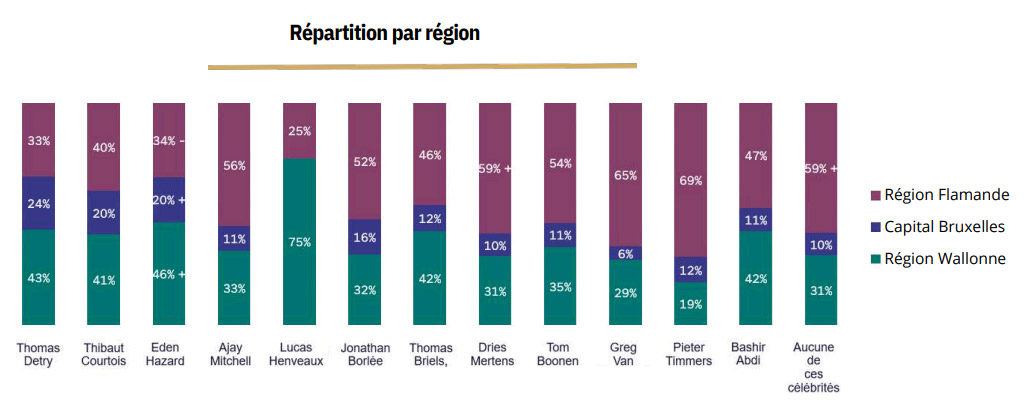
Younger generations favour modern, highly visible figures in the media. Regionally, Flanders and Wallonia show notable differences, particularly in the votes for certain local figures.
Eden Hazard and Thibaut Courtois attract significant interest among women, confirming their status as attractive figures beyond their sporting performances. Men’s choices are more varied, with interest in athletes from a range of disciplines, including cycling and athletics.

Responses are primarily centred around Nafissatou Thiam, cited by 24% of respondents, indicating very strong and almost immediate recognition.
Loena Hendrickx follows with 10% of the votes, while Lotte Kopecky and Kim Clijsters each receive 8%, demonstrating a strong attachment to athletes who combine sporting achievements with media visibility.
The remaining preferences are distributed relatively evenly: Ambre Ballenghien (6%), Sarah Chaari, Cynthia Bolingo and Chloé Herbiet at around 5%, followed by a number of less frequently cited names below this threshold.
Overall, the results reveal a fairly balanced landscape in which one iconic figure clearly stands out, while several other athletes coexist in the public imagination with similar levels of recognition.


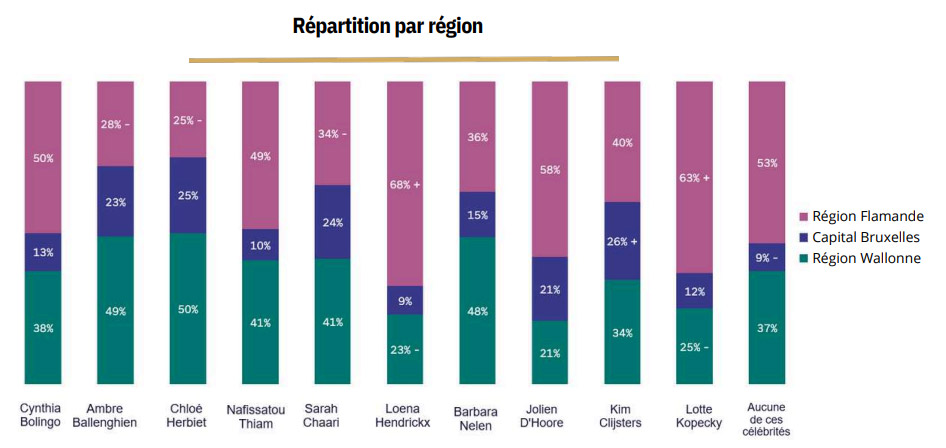
Belgian female athletes are considered attractive thanks to their fame and media exposure. Age strongly influences preferences, with a divide between younger people, who favour modern figures, and older generations, who identify less with today’s female athletes.
At regional level, differences can be observed between Flanders, Wallonia and Brussels. Some athletes receive stronger support in their region of origin.

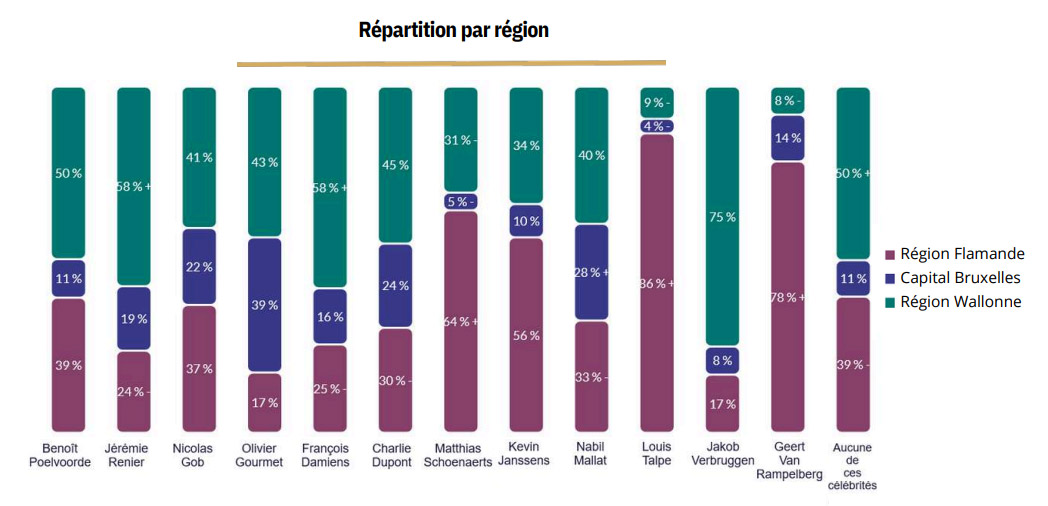
Preferences are primarily focused on Matthias Schoenaerts, who receives 19% of the votes and emerges as the most spontaneously cited figure.
A second group follows, with Louis Talpe (9%), Kevin Janssens (8%) and Jérémie Renier (7%), reflecting solid but more dispersed recognition.
The remaining votes are progressively distributed among several figures from Belgian cinema and media: François Damiens (6%), Nabil Mallat (5%), followed by Geert Van Rampelberg and Benoît Poelvoorde at around 4%.
Finally, several personalities are mentioned more occasionally, illustrating a broad landscape of recognition in which preferences become increasingly fragmented beyond the most immediately identifiable figures.


Women mainly vote for Matthias Schoenaerts and Kevin Janssens, confirming their attraction to charismatic and highly visible media figures. Men are more divided, with votes distributed more evenly among the candidates.
People aged 18–34 favour modern figures, particularly Matthias Schoenaerts, Kevin Janssens and Louis Talpe. Those aged 50 and over prefer more established figures such as François Damiens and Benoît Poelvoorde. Respondents aged 66+ are the most likely to answer “None of these celebrities”, reflecting a certain distance from these personalities.
Flemish regions show greater support for local actors, particularly Louis Talpe and Matthias Schoenaerts. Wallonia is more divided, with a more balanced representation of the different actors. Brussels shows a mix of both trends, supporting both French-speaking and Flemish figures.

Responses are mainly centred around Virginie Efira, cited by 24% of respondents, making her the figure most spontaneously associated with this category.
A second level of recognition emerges with Nathalie Meskens (13%) and Cécile de France (9%), who enjoy strong but more nuanced recognition.
Other actresses are mentioned less frequently, such as Ella-June Henrard (7%), Veerle Baetens (6%) and Émilie Dequenne (5%), reflecting more targeted recognition.
Finally, a significant proportion of respondents (15%) say they do not identify with any of these celebrities, suggesting a diversity of references or a certain distance from the proposed figures.


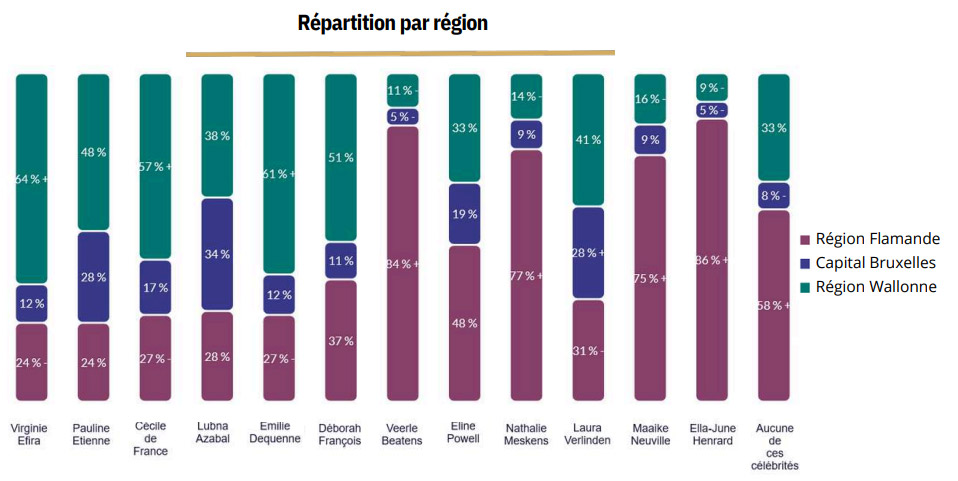
Virginie Efira is the undisputed icon of attractiveness in Belgium, with a clear lead over the other personalities. The generational divide is significant, with younger generations preferring modern figures, while older generations are less engaged in choosing celebrities.
Regional identity also plays a role, with preferences varying between linguistic communities. Men and women perceive attractiveness differently, with men favouring glamorous, highly visible media personalities, while women show more diverse preferences.
These results confirm that the perception of attractiveness in Belgium is strongly influenced by media image, cultural background and generational differences.

Responses are fairly dispersed, with a slightly stronger preference for Luc Gilson, cited by 10% of participants. He emerges as a recurring choice without overwhelmingly dominating the other profiles.
Nicolas Lacroix and Guillermo Guiz follow closely behind with 7% each, illustrating comparable recognition and well-established popularity among part of the public.
A second group includes César Casier (6%), followed by Philippe Geubels and Alex Agnew (both 5%), who remain recognisable but are mentioned less frequently.
Finally, several comedians are cited more marginally — at around 3% to 4% — including Robert Van Impe, Sacha Legrand, Medhy Malanda and Alain Gossuin, reflecting more dispersed recognition.


Young people (18–34) appear more likely to vote for new and dynamic figures such as Guillermo Guiz and Nicolas Lacroix, while older respondents favour Luc Gilson. A clear difference between Flanders, Wallonia and Brussels can also be observed: Walloon and Brussels respondents are more likely to agree on certain TV personalities, while Flemish respondents appear less attached to the media figures presented.
The majority of votes come from men, suggesting that these male TV personalities appeal more strongly to a male audience. Women appear less engaged in this type of ranking, which could explain the high abstention rate.

The responses reveal a fairly wide variety of profiles, with several personalities regularly standing out. Julie Van den Steen is the most frequently mentioned (13%), indicating strong visibility among respondents without creating an overwhelming lead.
Virginie Hocq (10%) and Julie Vermeire (9%) follow, emerging as well-recognised figures who are regularly cited within a relatively balanced field.
An intermediate group consists of Nawel Madani, Gaëlle Garcia Diaz and Laura Beyne, with scores ranging from 6% to 8%, reflecting solid but more targeted recognition.
Finally, several names are mentioned less frequently — at around 3% to 5% — including Céline Dept, Chloé Kitembo and Kenza Ameloot, confirming the fragmented nature of preferences.


Men are more likely to vote for female figures associated with media glamour, such as Nawel Madani and Gaëlle Garcia Diaz. Women show a more balanced distribution in their votes, with greater attention paid to personalities known for their charisma and authenticity.
Younger generations (18–34) favour personalities from social media or emerging media trends. Older age groups are more likely to choose established figures from television or comedy.
Personalities from Flanders appear to enjoy greater recognition than those from Wallonia or Brussels. The regional distribution shows a clear influence of local culture and media exposure.

This chart highlights several musical figures who are mentioned more frequently than others, without completely dominating the remaining responses. Stromae is cited by 14% of respondents, confirming his status as a major cultural reference across generations.
Close behind, Metejoor (11%) and Loïc Nottet (10%) represent a highly recognisable contemporary Belgian music scene, combining media visibility with distinctive artistic identities. Damso follows closely with 9%, illustrating the importance of French-language rap in the preferences expressed.
A second group then emerges with more moderate but consistent scores: Pierre de Maere (6%), Lost Frequencies and Henri PFR (around 5%), reflecting an attachment to well-established artists within their respective genres.
Finally, less frequent mentions — such as Roméo Elvis, Tourist LeMC and Green Montana — demonstrate the diversity of musical tastes, with more niche preferences that nevertheless remain present.


People aged 18–34 favour modern and dynamic figures such as Metejoor and Loïc Nottet. In Flanders, Dutch-speaking artists logically dominate, including Metejoor and Tourist LeMC.
In Wallonia, Stromae, Loïc Nottet and Damso are more prominent. Brussels shows a more mixed distribution, with a certain balance between French-speaking and Dutch-speaking artists. Women appear more attracted to artists with a carefully crafted image and distinctive style, such as Stromae, Loïc Nottet and Pierre de Maere.

This chart shows that preferences are concentrated around a few well-known artists, followed by a gradual dispersion towards other figures from the music scene. Angèle clearly stands out, cited by 27% of respondents, reflecting strong recognition and a significant sense of cultural connection.
A second group emerges with Pommelien Thijs (11%) and Axelle Red (10%), illustrating a balance between contemporary artists and figures who have long been established in the Belgian music scene.
Other names appear more diffusely — including Shay, Selah Sue, Mentissa and Camille Dhont — reflecting more specific but nevertheless well-distributed preferences.
Finally, the significant proportion of respondents choosing “none of these celebrities” (10%) shows that part of the public does not identify with these references, highlighting the diversity of tastes and musical preferences within the sample.


Angèle confirms her status as an icon of attractiveness, particularly among men and younger generations. Preferences vary considerably by region and age, with a divide between modern figures and more traditional icons. Young people (18–34) favour Angèle and Shay, attracted by their modern and fashionable image, while older respondents (50–65 and 66+) are more likely to choose established figures such as Axelle Red.
Walloon respondents vote overwhelmingly for Angèle, while Flanders is more divided between Pommelien Thijs and Selah Sue.
Male votes are dominated by Angèle, who strongly appeals to this audience. Female votes, by contrast, are more varied, with preferences distributed between Axelle Red, Shay and Selah Sue.
Some figures are more popular in Wallonia, such as Angèle and Matthias Schoenaerts. Others appeal more strongly in Flanders, such as Pommelien Thijs and certain Flemish sports figures. Bilingual or internationally recognised personalities, such as Virginie Efira and Eden Hazard, are better received across the country.
Men prefer glamorous and highly visible media personalities such as Angèle, Nafissatou Thiam and Virginie Efira.
Women place greater importance on charisma and longevity, voting more frequently for Matthias Schoenaerts, Eden Hazard and established figures such as Axelle Red.
Study conducted by:
Audrey Mandefield, Senior Account Executive
Pauline Poché, Insight Team Lead
TO CITE THIS STUDY, AT LEAST THE FOLLOWING WORDING MUST BE USED:
“Discurv study for XloveCam conducted in December 2024 through a self-administered online questionnaire among a representative sample of 1,000 Belgian residents aged 18 and over.”