

February 2025
This new study follows on from previous surveys conducted by Discurv for XloveCam among Europeans on the sexiest celebrities in France, Italy and other countries.

Marcel Hirscher clearly stands out from the rest of the ranking with 29% of the votes, 12 points ahead of David Alaba. He alone accounts for nearly 4 out of 10 votes among the athletes mentioned, reflecting a very strong and widely shared image of attractiveness.
Behind him, David Alaba (17%) and Dominic Thiem (14%) form a relatively close middle group, with a gap of only 3 points, indicating a comparable level of perceived attractiveness.
Marcel Sabitzer receives 10% of the votes, placing him in a secondary but clearly identifiable position. He benefits from a certain level of visibility without, however, competing with the leading figures.
Finally, Matthias Mayer comes last with 6%, 23 points behind Marcel Hirscher, suggesting lower recognition or sex appeal according to this criterion.

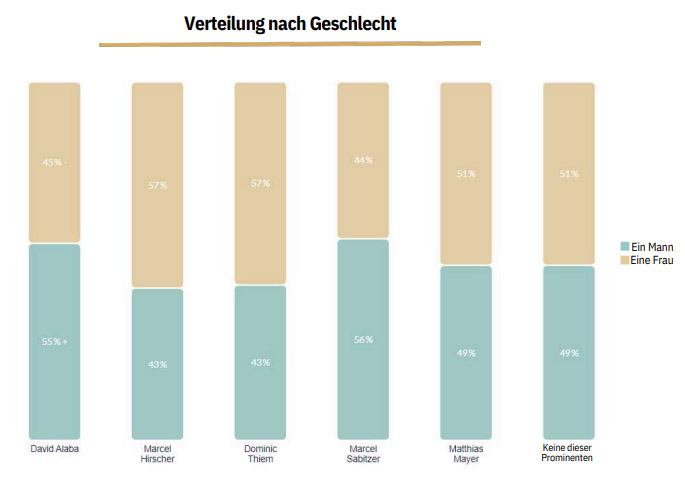
Marcel Hirscher also tops the ranking, particularly among women (57%) and older generations.
As one of Austria’s most successful skiers, he enjoys strong national recognition, supported by significant media exposure and a simple, authentic charisma.
David Alaba, meanwhile, is preferred by younger generations and men. His international football career makes him particularly attractive to 18–34-year-olds. While skiing is deeply rooted in Austrian culture, football remains more popular worldwide.
Overall, skiers and tennis players are more widely recognized in Austria than footballers because they are more closely associated with national sporting traditions.



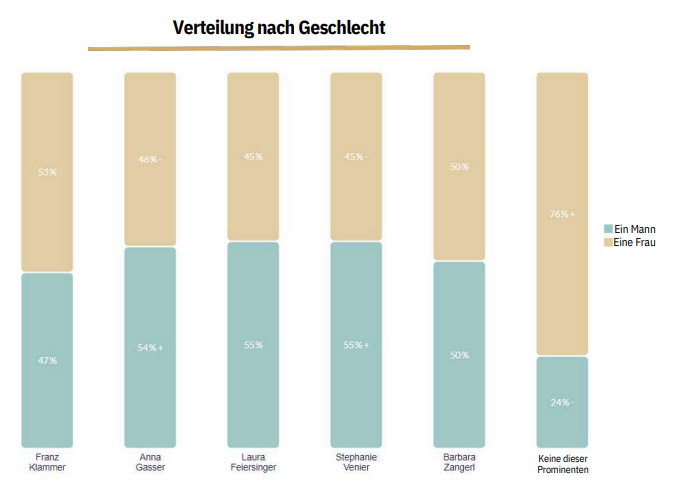
Anna Gasser clearly dominates the ranking with 38% of the votes, 17 points ahead of Stephanie Venier. She alone accounts for nearly 4 out of 10 votes, reflecting an extremely strong image in terms of attractiveness and significantly greater recognition than the other female athletes mentioned.
Stephanie Venier comes second with 21%, forming a clear middle tier but remaining well behind the leader. Her score indicates strong recognition without challenging Anna Gasser’s dominance.
Laura Feiersinger receives 11% of the votes, 10 points behind Stephanie Venier. She occupies a secondary position, recognizable but clearly less prominent in the collective imagination.
Franz Klammer (6%) and Barbara Zangerl (5%) complete the ranking with low and very similar scores. Their perceived attractiveness remains marginal within this panel, with a gap of more than 30 points compared with the top position.
The younger generation (18–34) shows a particular preference for Anna Gasser and Barbara Zangerl, highlighting the growing importance of new faces in sport.
Stephanie Venier and Laura Feiersinger enjoy more balanced popularity across age groups, reflecting their well-established recognition.
Votes are also evenly distributed between men and women, illustrating a shared appreciation of these athletes.



Christoph Waltz clearly dominates the ranking with 30% of the votes, 14 points ahead of Philipp Hochmair. He alone accounts for almost a third of all votes, making him the male figure most strongly associated with attractiveness in this category. His international image, charisma and media recognition clearly work in his favor.
Philipp Hochmair comes second with 16%, almost half Christoph Waltz’s score. Nevertheless, he holds a solid middle position, indicating genuine perceived attractiveness, although with less widespread appeal.
Manuel Rubey receives 11% of the votes, 5 points behind Philipp Hochmair. He is among the recognizable figures but does not reach a level of attractiveness comparable to the top two.
Robert Finster and Laurence Rupp complete the ranking with 6% each. Their perceived attractiveness remains marginal, with a 24-point gap compared with the leader, suggesting more limited recognition or sex appeal among the surveyed panel.
Among older generations, Christoph Waltz dominates thanks to his international career and distinctive charm. Laurence Rupp appeals more strongly to younger generations, indicating a shift in preferences toward more modern figures in cinema.
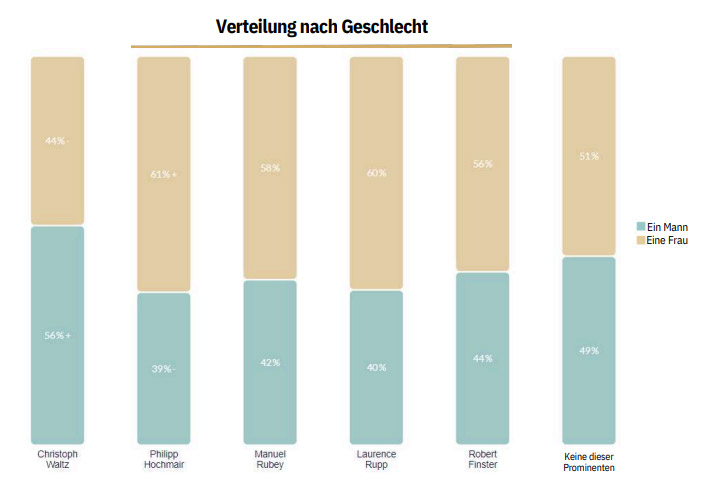
Perceptions of actors’ attractiveness are relatively balanced between men and women, although distinct preferences emerge depending on age.
Women tend to prefer younger and more modern actors, while men favor established and charismatic figures.
The choice of a “sexy” actor is strongly influenced by public image, roles and fame.
These results reveal a diversity of opinions: each generation and gender identifies with different figures.


Emily Cox clearly ranks first with 22% of the votes, 9 points ahead of Stefanie Reinsperger and Nora von Waldstätten, who are tied for second place. She alone accounts for more than one-fifth of the votes, making her the female figure most clearly associated with attractiveness in this panel.
A very tight middle group follows, with Stefanie Reinsperger and Nora von Waldstätten at 13% each, closely followed by Amira El Sayed at 12%. The maximum gap between these three actresses is only 1 point, indicating almost identical levels of perceived attractiveness and no clear hierarchy among them.
Valerie Pachner completes the ranking with 9%, 13 points behind the leader. Her score nevertheless remains significant, indicating existing recognition but a more limited appeal in terms of attractiveness.
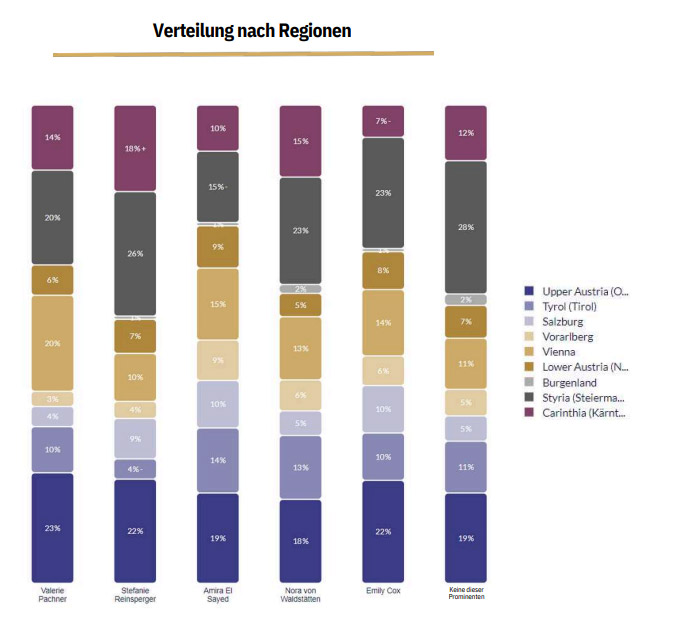
Emily Cox is particularly popular among men (55%) and 18–34-year-olds (38%).
Her presence in well-known productions and her modern style appear to play a decisive role in how she is perceived.
Younger respondents favor Emily Cox and Amira El Sayed, who correspond more closely to contemporary beauty standards, while those over 50 prefer Stefanie Reinsperger and Nora von Waldstätten, who are associated with more traditional productions.

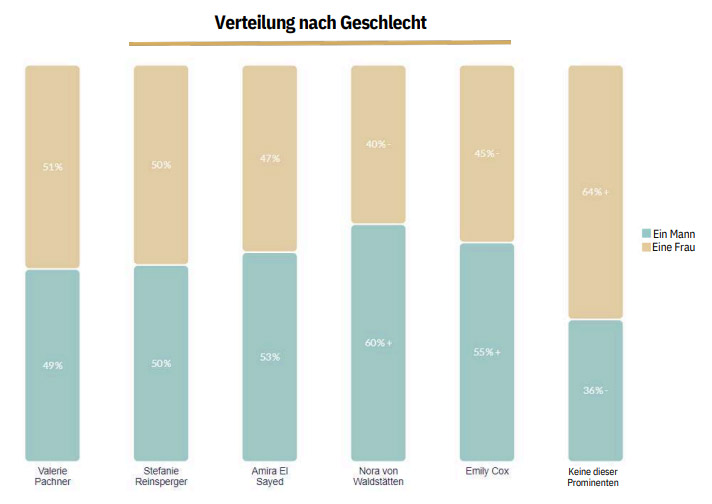

Andi Knoll clearly dominates the ranking with 25% of the votes, 13 points ahead of Florian Gschaider and Fabio Wibmer. He alone accounts for a quarter of all votes, making him the personality most strongly associated with attractiveness in this category. His established media image and high visibility play a decisive role.
A second middle group consists of Florian Gschaider and Fabio Wibmer, both with 12%. Their tie reflects a comparable level of perceived attractiveness, although significantly lower than that of the leader. They nevertheless remain clearly recognizable figures among the public.
Johannes Bartl receives 9% of the votes, 3 points behind the middle group. He occupies a secondary position, benefiting from existing but more targeted recognition.
RADAL comes last with 2%, a very marginal score indicating significantly lower recognition or sex appeal within this panel.

Young people (18–34) prefer Fabio Wibmer and Johannes Bartl, influential figures from social media and the digital world.
Men are more attracted to active and sporty personalities such as Fabio Wibmer and RADAL, while women show more balanced and varied preferences.

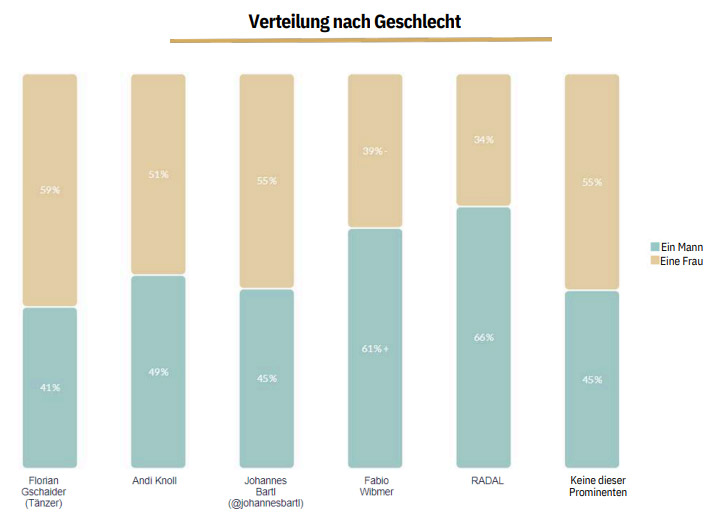

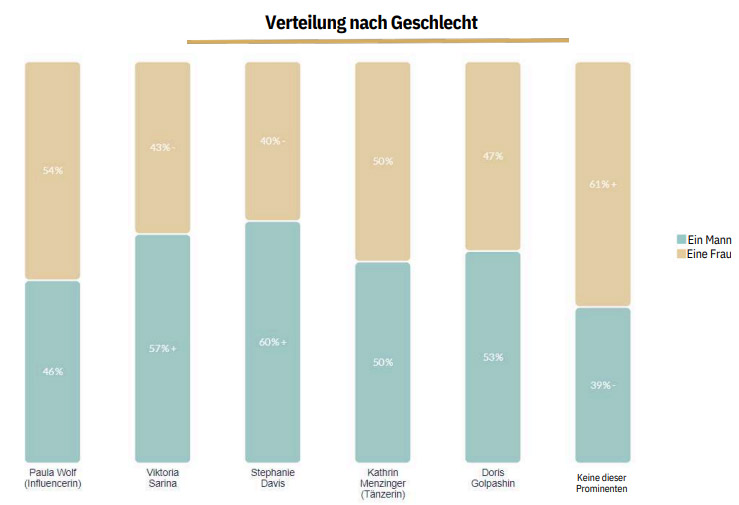
Kathrin Menzinger ranks first with 21% of the votes, 9 points ahead of Viktoria Sarina. She alone accounts for just over one-fifth of the votes, making her the female figure most clearly associated with attractiveness in this category. Her artistic profile and strong media visibility largely explain her leading position.
Behind her, the ranking is extremely close. Viktoria Sarina receives 12%, while Paula Wolf, Doris Golpashin and Stephanie Davis each receive 11%. The maximum gap between these four personalities is only 1 point, indicating almost identical levels of perceived attractiveness and no clear hierarchy within this group.
This closeness in scores shows that, unlike other more polarized categories, no secondary figure clearly manages to stand out from the others.

Kathrin Menzinger dominates, particularly among 35–49-year-olds, thanks to her fame and her elegant, dynamic image.
Paula Wolf is particularly popular among 18–34-year-olds, highlighting the growing influence of social media personalities on perceptions of attractiveness.
Women are more receptive to emerging figures from digital media, which helps explain their preference for Viktoria Sarina and Paula Wolf.
Men favor a more traditional view of attractiveness, often associated with established media personalities.
Attractiveness criteria differ according to gender:
The variety of responses shows that perceptions of attractiveness are evolving significantly under the influence of media and cultural trends.


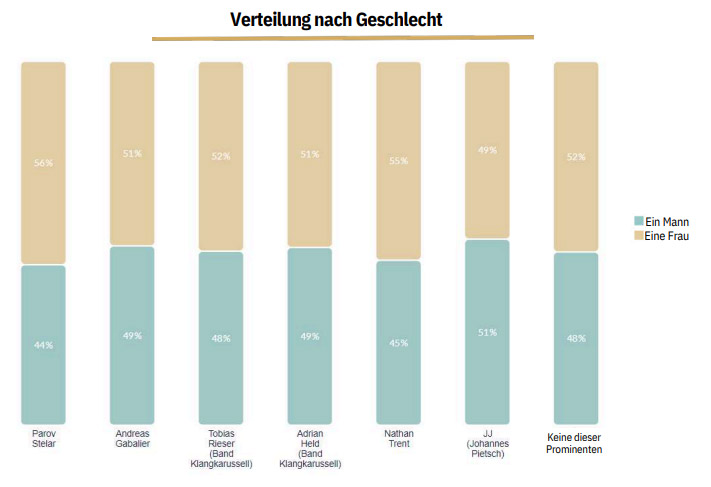
Andreas Gabalier overwhelmingly dominates the ranking with 37% of the votes, 29 points ahead of Nathan Trent and Parov Stelar. He alone accounts for more than a third of the votes, making him the overwhelmingly dominant male figure in this category. His strong public image, cultural roots and media recognition largely explain this commanding lead.
Behind him, the scores drop sharply. Nathan Trent and Parov Stelar are tied at 8%, forming a secondary group far behind the leader and without any real ability to challenge him.
Adrian Held (6%) and Tobias Rieser (5%), both members of Klangkarussell, occupy more marginal positions, with low but consistent scores reflecting existing but limited recognition in terms of attractiveness.
JJ (Johannes Pietsch) comes last with 4%, a very small share indicating more limited visibility or sex appeal within the panel.
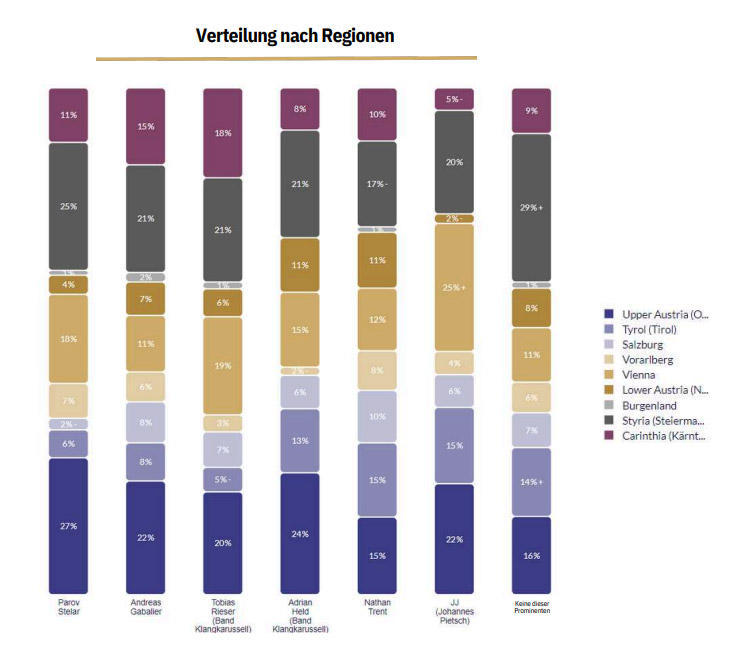
Andreas Gabalier ranks first thanks to his iconic image and loyal fan base, particularly among 35–49-year-olds and older respondents.
Younger people prefer more modern artists such as Nathan Trent and JJ, who are more closely connected to current trends and digital platforms.
Men tend to favor established figures, while women appear more open to newer and alternative artists.
One-third of respondents do not identify with any of the proposed singers, revealing a wide variety of expectations and ideals of attractiveness.


Christina Stürmer overwhelmingly dominates the ranking with 53% of the votes, 42 points ahead of Tina Naderer. She alone accounts for more than half of all responses, making her the most widely agreed-upon female figure in terms of attractiveness across all the charts analyzed so far.
Tina Naderer comes second with 11%, although her score is nearly five times lower than Christina Stürmer’s. She represents a recognizable secondary figure without posing any real challenge to the leader.
Mavi Phoenix and PAENDA each receive 5% of the votes, forming a very marginal group, 48 points behind the top position. Their perceived attractiveness is limited to more niche audience segments.
Soap&Skin comes last with 4%, confirming limited visibility in terms of attractiveness despite existing artistic recognition.
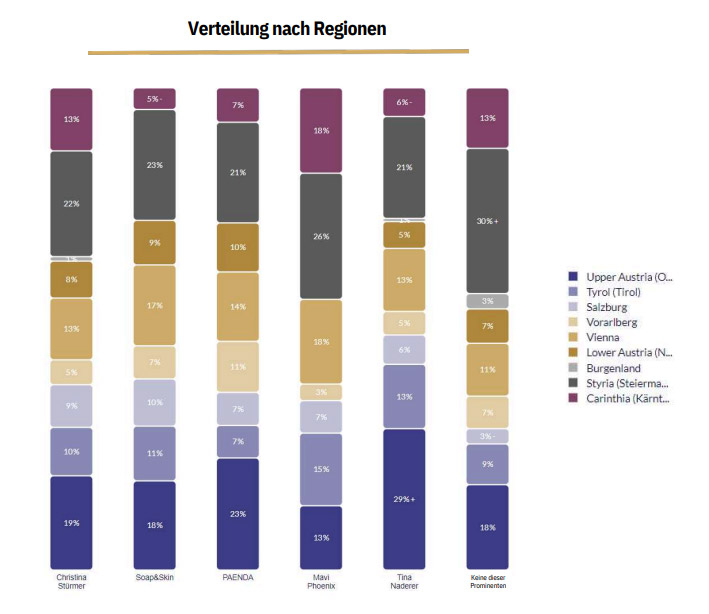
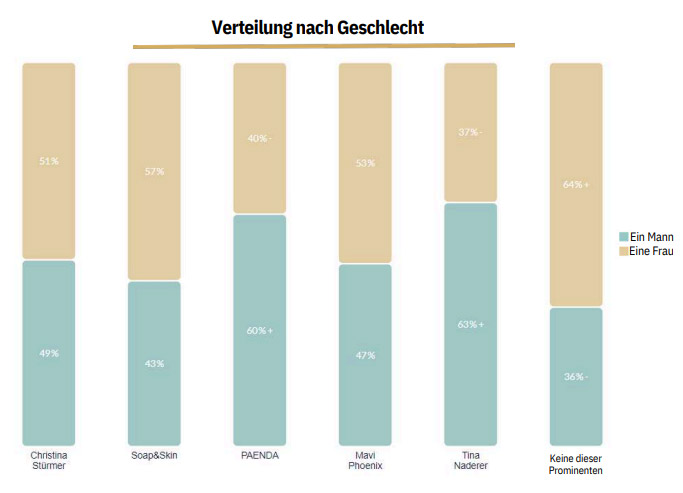
Christina Stürmer is the clear favorite, enjoying balanced popularity across all age groups and particularly strong recognition among women.
She embodies a natural and approachable beauty that appeals to a broad audience.
Her style is both modern and timeless, attractive without appearing eccentric.
Her authenticity and simplicity make her relatable to her fans.
Younger generations prefer contemporary artists such as Mavi Phoenix and PAENDA, who have a stronger presence in digital media.
Men are more likely to choose Tina Naderer and PAENDA, while women strongly favor Soap&Skin and Christina Stürmer.

The best-known personalities consistently dominate the rankings:
Emerging or niche artists struggle to stand out:
The greater a celebrity’s media exposure, the more likely they are to be perceived as attractive.
Women are more selective and more hesitant to describe a personality as “sexy”:
Men are more open and distribute their votes more evenly:
Women appear to value authenticity and identification more strongly, while men accept a broader range of attractiveness criteria.
Young people (18–34) prefer modern personalities from social media.
Mavi Phoenix and Paula Wolf perform particularly well within this age group.
People aged 35–49 and those over 50 prefer established stars from traditional media.
Christina Stürmer, Andreas Gabalier and Marcel Hirscher dominate thanks to their longevity.
Perceptions of attractiveness therefore vary significantly according to age.
Athletes and musicians remain the most popular figures.
Figures from social media or alternative niches struggle to appeal beyond younger generations.
Traditional media continue to shape dominant perceptions of attractiveness.
Study conducted by:
Audrey Mandefield, Senior Account Executive
Pauline Poché, Insight Team Lead
TO CITE THIS STUDY, PLEASE USE AT LEAST THE FOLLOWING WORDING:
"Discurv study for XloveCam, conducted in December 2024 through a self-administered online survey among a representative sample of 1,000 Austrians aged 18 and over."