




A condom that changes color when detecting an STI? Innovation, figures, humor and prevention: discover S.T.EYE, the crazy idea of three teenagers.
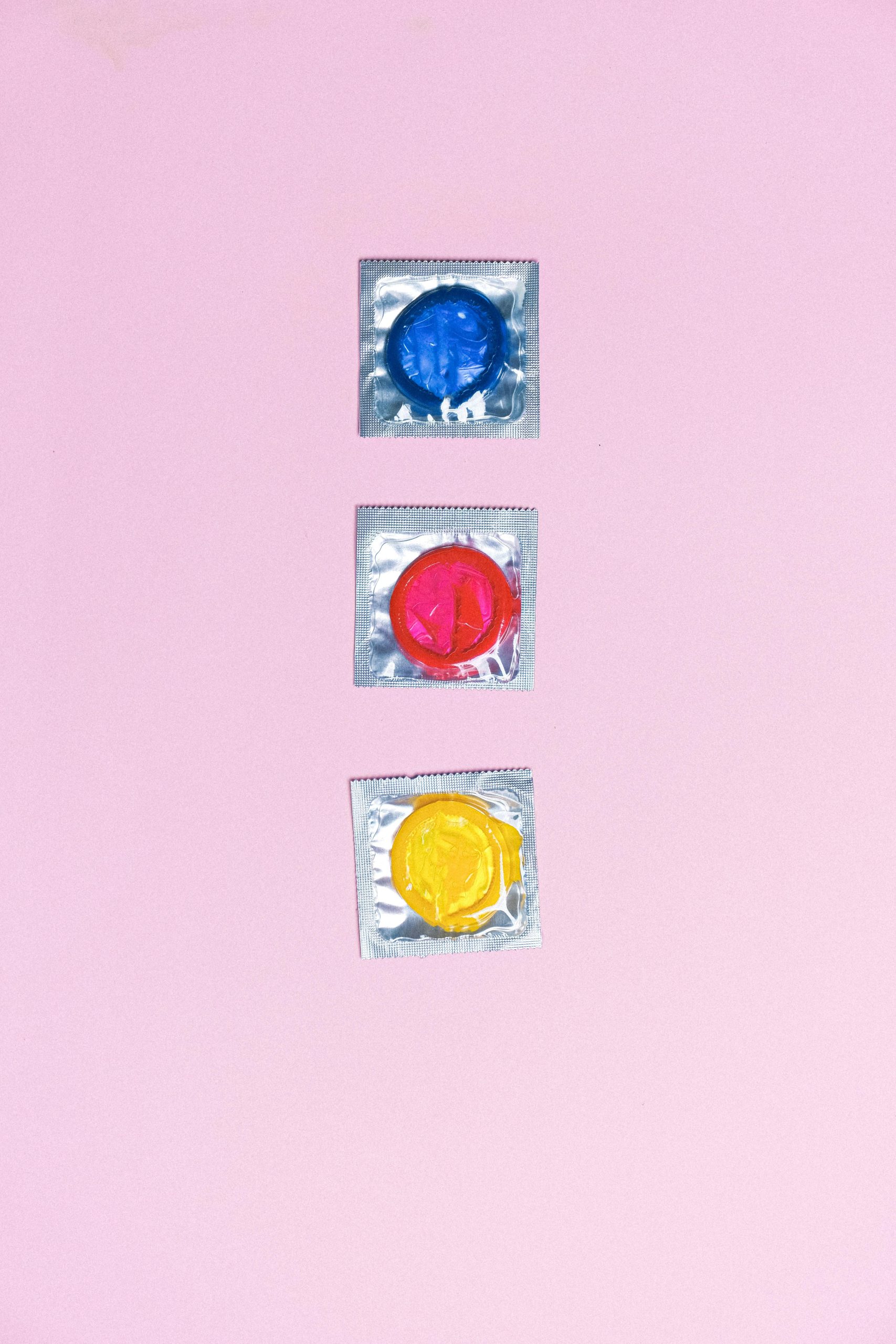
Photo Shvetsa
We already knew about flavored, phosphorescent, extra-thin, ribbed condoms… but in 2015, three British teenagers had an even more revolutionary idea: a condom that changes color if it detects a sexually transmitted infection.
Picture the scene: you roll on your condom and it turns green, blue or purple. No microbiology doctorate needed, latex makes the diagnosis in real time. Embarrassing? Probably. Useful? Potentially revolutionary.
And this is not a myth, its been a reality for a few years. So let me tell you about an unusual invention that raises real public health questions at a time when STIs are exploding.
An invention born in the schoolyard
At just 13 and 14 years old, Daanyaal Ali, Muaz Nawaz and Chirag Shah, three students from Isaac Newton Academy (Ilford, Essex), designed in 2015 the S.T.EYE (a play on words between STI » – sexually transmitted infections – and eye »).
Their smart condom, coated with specific molecules, reacts chemically when it comes into contact with bacteria or viruses, changing color:
- Green: chlamydia
- Yellow: herpes
- Purple: human papillomavirus (HPV)
- Blue: syphilis
👉 Discreet, painless, and without going through the stressful step of seeing a doctor. Result: the three teenagers won the Health » prize at the TeenTech Awards, a £1,000 cash prize, and even an invitation to Buckingham Palace.
A beautiful reward for an idea that had both the charm of simplicity… and the potential of a health earthquake.
How does it work (in theory)?
The principle is based on antibodies integrated into the latex. When they encounter the antigens of infections, a chemical reaction occurs, changing the color of the condom. Its the same type of reaction found in some rapid tests (like ELISA for HIV).
Easy on paper, much more complex in practice. You need to guarantee scientific reliability without false positives or negatives, while using non-irritating products for mucous membranes. And then, a silly question: what happens if your partner carries multiple STIs? Rainbow guaranteed?
A brilliant innovation… and controversial
Naturally, the idea triggered enthusiasm and skepticism.
On one hand, its the promise of immediate, discreet and non-invasive testing, a great educational tool for young people, and a way to democratize screening.
But on the other hand, criticism abounds. You can easily imagine the embarrassing scene of a condom turning blue at the worst possible moment. Added to that are ethical questions (right to privacy, managing intimate information in real time), the still fragile reliability of the device, and even a perverse psychological effect: the fear of using such a condom for fear of the verdict.
Dr. Mark Lawton (BASHH, UK) and Michel Bourrelly (CRIPS, France) both highlighted these limitations. Seductive gadget, yes, but not necessarily realistic in real life.

Photo Cottonbro
Where are we in 2025?
Ten years after its buzz, S.T.EYE has still not landed on supermarket shelves. But it remains an iconic prototype regularly cited in innovation competitions.
Research, however, is advancing: STI rapid tests are becoming increasingly reliable, connected condoms exist (rather for measuring performance »), and biodegradable, vegan or high-tech condoms are multiplying.
In short, the chameleon condom remains a scientific fantasy… but it has at least brought screening back to the center of discussions.
STIs: a global problem in full boom
Behind the humor, the figures are clear: STIs are not an old memory of the 90s, but a current health emergency. The World Health Organization estimates that one million people contract an STI every day worldwide. In France, Santé publique France notes a continuous increase since the 2000s.
Diseases once thought to be disappearing are making a big comeback, like syphilis, almost eliminated in the 90s and experiencing a worrying resurgence since 2000, especially among men who have sex with men. Chlamydia and gonorrhea, on the other hand, spread mostly among young adults, often without visible symptoms. As for HIV, it remains a firmly entrenched reality: around 6,000 new infections each year in France, with a significant proportion concerning those under 30.
Why are these figures exploding? Because the condom, once seen as a given post-AIDS crisis, has lost its popularity. Many young adults prioritize immediate comfort over safety. Dating apps multiply the occasions for quick contacts, but not necessarily for serious discussions about prevention. Add to that a lack of regular screening – out of negligence, fear of judgment or simple ignorance – and you get the perfect recipe for a massive rebound of infections.
The problem is that most of these infections are silent: no symptoms, no pain, nothing that alerts you. Which doesnt prevent the consequences from being serious: infertility, chronic complications, facilitated HIV transmission. To say the least, beyond technological innovation, the real urgency remains education and simplified access to screening.
Why this invention remains inspiring
Even if it is not yet commercially available, the idea of S.T.EYE remains a stroke of pedagogical genius. It made people talk about STIs all over the world, it raises awareness by making the danger visible, and it empowers without moral judgment.
And lets be honest: if three 14-year-olds could come up with this in their classroom, medical science can surely go even further.
In practice: how to stay protected today?
Until the rainbow condom arrives, the most effective approach remains the basics: systematically use male or female condoms, get tested regularly, talk about prevention with your partners (yes, communication can be sexy), and above all, dont wait for symptoms to appear before consulting. The majority of STIs are asymptomatic, and thats precisely the trap.

Photo Klaus Nielsen
Final word
The color-changing condom is both a gadget, a scientific dream, and a symbol. A gadget, because its practical implementation is still far off. A dream, because it could transform prevention. A symbol, because it reminds us that STIs are far from being an outdated topic.
So perhaps one day, in your bedside drawer, youll have the choice between the vanilla condom, the vegan condom… and the chameleon condom. Until then, protect yourself, get tested, and remember: the real color of sex is that of trust and respect.
XLoveCam is not responsible for the content of the blog which is stated to be written by an external party.