




While clothing historically serves a function of protection and modesty, its most astonishing role lies in its ability to arouse desire. Paradoxically, complete nudity is often less erotic than a skillfully dressed body; for where nudity exposes, fabric suggests. Indeed, clothing is not a simple barrier against the gaze; it is the center of a universe between the « hidden and the revealed. »
A silent language where each texture—the coldness of latex, the suppleness of leather, or the fineness of lace—becomes an extension of sensuality. Through the fetish, the inanimate object comes to life and substitutes for the body itself, transforming the act of dressing into a staging of fantasy. Together, we will explore how clothing, far from stifling libido, becomes the primary instrument of its exaltation.
The Dance of the Hidden/Revealed
Eroticism does not reside in complete nudity, which is a state of fact, but in the movement that leads to it or suggests it. Clothing is the primary instrument; it plays on the paradox between the obstacle it represents and the promise it contains.
The Paradox of Modesty
Contrary to popular belief, modesty is not the enemy of eroticism; it is its sine qua non condition. By concealing the body, it confers upon it more value and rarity. As Roland Barthes highlighted in The Pleasure of the Text, the most erotic place on a body is « where the garment gapes. » Indeed, modesty creates a mystery that excites the imagination: what is hidden becomes a treasure to be discovered.
The Obstacle: Engine of Desire
Clothing acts primarily as a physical boundary that sanctifies the body. However, this barrier should not be perceived as a simple refusal, but rather as a challenge. Indeed, the act of undressing then becomes a consented transgression, a progression towards a conquered intimacy. Furthermore, the material obstacle (buttons, laces, zippers) imposes a rhythm, a slowness that ritualizes access to the body.
The more sophisticated the barrier, the more the transition to nudity gains in dramatic intensity. This complexity transforms dressing into a true architecture of resistance where each layer of fabric reinforces the value of what it conceals.
Transition Zones: Necklines, Slits, and Transparencies
Erotic interest is particularly fixed in the border zones, where the fabric stops or becomes uncertain.
Necklines and slits: these breaks in the continuity of the garment create visual air gaps. They act as frames that isolate a portion of skin, making it more precious.
Transparency: the veil or lace introduces a troubling dimension. One no longer knows if one is looking at an object or a body. The skin is seen without being offered, touched by the gaze through a filter that idealizes it.
The in-between: these are the spaces (the wrist protruding from a sleeve, the exposed nape of the neck, etc.) that constitute the true points of fixation, because they keep the mind in a state of suspense between restraint and abandon.
The Tactile Sensuality of Materials
Material is no longer just a rampart; it is a true sensory experience that becomes a tactile language prefiguring contact with the skin.
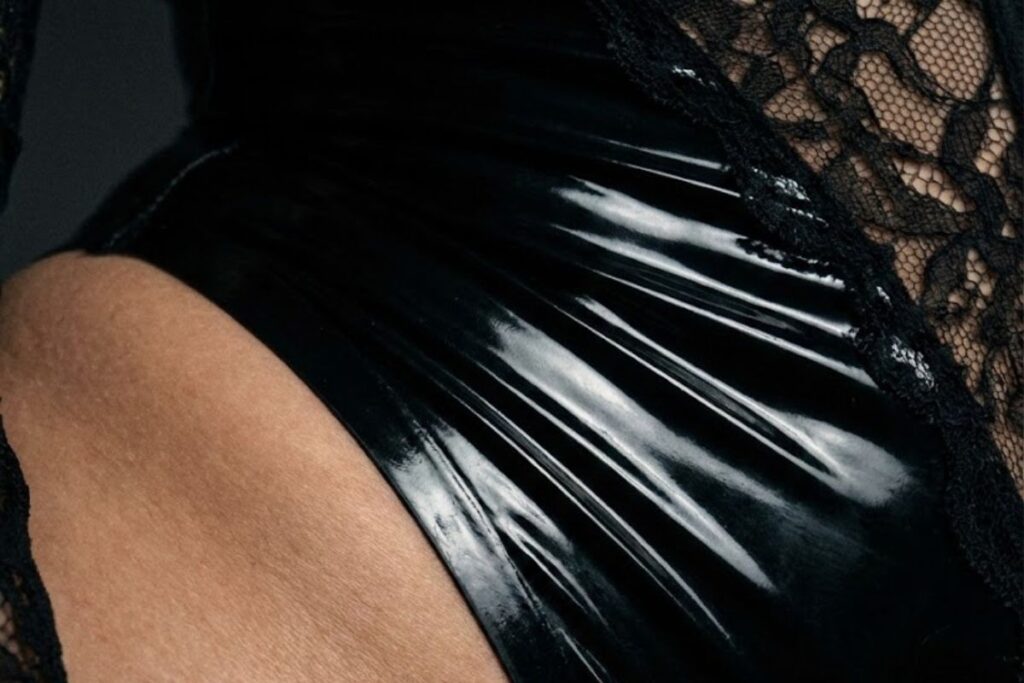
Leather and latex: they embody a form of radical resistance. Through their rigidity or adherence, these materials constrain the body while exalting it. Leather imposes its roughness and animal smell, while latex, like a shiny synthetic second skin, accentuates forms through a compression that makes every movement conscious. Here, the boundary is hermetic, almost impenetrable, transforming the garment into an armor of desire.
Silk and lace: these materials play on the subtlety of the invitation. Silk, through its thermal fluidity and extreme softness, seems to glide. It evokes a resistance that only asks to yield. Lace, for its part, is a paradoxical boundary; it fragments nudity without completely hiding it. It creates a play of shadows and textures where the skin is both revealed and ornamented, making the garment a filter more than an obstacle.
The weight of textures influences the psychology of abandon. The heaviness of velvet or woolen cloth provides a feeling of security and gravity, while the lightness of muslin suggests the ephemeral. This weightiness of materials dictates the fall of the garment to the ground, a dull thud or a light rustle marking the ultimate stage of the passage from architecture to pure intimacy.
Clothing as a Symbol of Power and Role
Clothing goes beyond the simple function of protection to become a complex language of domination, submission, and theatricalization of identity. Through the uniform, the ritual, and the accessory, it sculpts not only the body but also the individual’s place in the hierarchy of desire and the social.
The uniform: it is the ultimate tool of depersonalization in favor of a function. It imposes a rigid structure that transforms the individual into a symbol of power. Indeed, by donning the uniform, the subject disappears behind their rank or institution. The outfit becomes a psychological armor that dictates behavior and forces ascendancy or fear.
The paradox of nudity: removing a uniform is not an insignificant gesture; it is an act of disarmament. Moving from supreme authority to the vulnerability of the flesh creates a contrast that reinforces intimacy.
Ritualized undressing: undressing is not just the opposite of dressing; when ritualized, it becomes a performance where time is suspended. Unlike immediate nudity, which can be banal, this ritual uses clothing as a sacred veil. Note that clothing acts like a lock. The ritual transforms the observer into an initiate who must wait for the barriers to fall one by one.
The Fetishism of the Accessory
The accessory is not a simple addition; it is an aesthetic asset that modifies the perception of the body and its interactions.
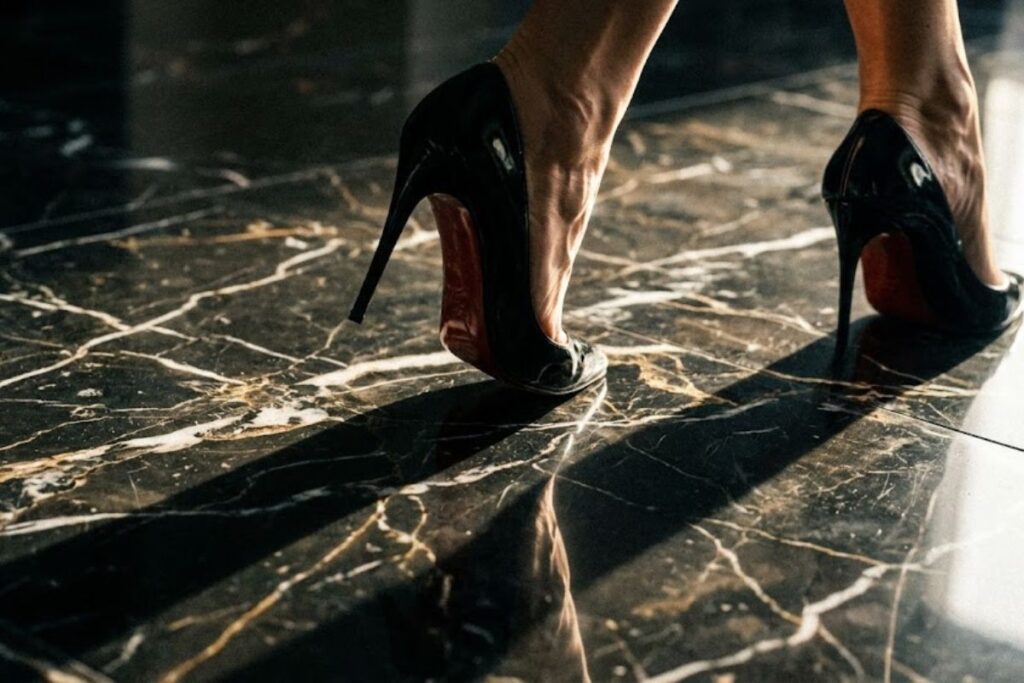
High heels: this is an accessory that defines balance; it modifies the silhouette. Indeed, by raising the heel, the accessory projects the pelvis forward, arches the back, and shapes the calf. Furthermore, the heel imposes a slower, more precarious gait. This paradox between elevation (the power of height) and fragility (the risk of falling) creates an eroticism of controlled vulnerability.
Gloves: The glove is the accessory of distance and distinction. By concealing the skin, the glove preserves the purity and anonymity of contact. Touching skin with a leather or satin glove means mediating desire through material.
The ritual of removal: removing a glove finger by finger is a gesture of extreme sensuality, signifying that the barrier between the two beings is diminishing.
In essence, the fetish garment transcends its utilitarian function to become a complex erotic language. Between the staging of power and the sublimation of desire, it metamorphoses the body into an object of worship. This boundary between fabric and skin thus reveals the close correlation between social identity and the most intimate fantasies.