


A silhouette disappears around a corner of the casbah, leaving behind a trail of musk and jasmine. A flutter of eyelashes underlined in deep black, a henna-adorned hand adjusting a silk veil, a crystalline laugh echoing behind a cedar door… For centuries, the West has shivered at the mention of the Oriental woman. But what does this veil of mystery truly conceal? Is it the fruit of a fertile European imagination in search of exoticism, or the expression of a thousand-year-old sensuality, codified and burning? Let us dive into this universe where desire feeds on shadow and light.
The Mirror of Dreams: The Western Invention of the Orient
It often begins with a painting. Imagine the Parisian salons of the 19th century, where people marvel at the canvases of Delacroix or Ingres. They depict the odalisque, that absolute fantasy figure, lasciviously stretched out on velvet cushions, surrounded by hookah vapors. This construction, analyzed by Edward Said in his foundational work Orientalism, is not the reality these painters captured, but their own thirst for the forbidden. In this imagination, the Arab woman is a magnificent captive, a promise of slow pleasures and muted submission. This mirage has frozen in our minds a cliché: that of an available sensuality, cloistered in a legendary harem, fueling an eroticism of anticipation that still persists in our contemporary films and novels.
This fantasy of the exotic « object-woman » is, however, merely a psychological construct. The unknown fascinates because it allows us to project our own unavowed desires. By enveloping the Oriental woman in a halo of inaccessible mystery, the collective male unconscious created an erotic pedestal where lack becomes the main driver of passion. Mysterious charm is born here: not from what is seen, but from what is imagined behind the closed door of the palace. It is exoticism as a catalyst, transforming otherness into an invitation to a carnal journey.
The Alphabet of Kohl: The Power of a Smoldering Gaze
If the body withdraws, the eye becomes the center of the world. In cultures where modesty is elevated to a cardinal virtue, seduction had to invent alternative paths, more subtle and perhaps more devastating. This is where the art of Kohl comes in. This ancient, charcoal-black line is not only used to protect against the desert’s glare; it transforms the gaze into a precision weapon. A single flutter of eyelids becomes a confidence, a glance becomes a promise. The gaze of the Arab woman does not merely see; it envelops, it probes, and it invites a silent dialogue where every shadow cast on the iris tells a story of desire.
This mastery of suggestion is the very essence of Oriental eroticism. Where immediate nudity can sometimes saturate desire, the mystery of a partially unveiled face multiplies it. It is an eroticization of detail: the curve of an eyebrow, the depth of a pupil, the delicacy of a temple. By focusing attention on the « windows of the soul, » Oriental culture developed a science of fascination that places the man in the position of a decipherer. One does not possess this gaze; one tries to lose oneself in it, and it is in this loss of bearings that the true charm lies, the one that never wears out.
The Breath of Words: Sensuality in Literature
Before being a physical practice, desire is a song. It is crucial to include the intellectual and lyrical dimension of this sensuality. Arab women, as poets or muses, have historically used poetry and prose to express a sophisticated passion, far from the clichés of submission. In the Arab tradition of love, desire is often formulated through floral metaphors and astral images, where the quest for the beloved is as much a spiritual exploration as a carnal one. This literary tradition proves that charm lies not only in appearance, but in the depth of the mind and the ability to sublimate anticipation.
The Skin of Secrets: Rituals of Silk and Regional Diversity
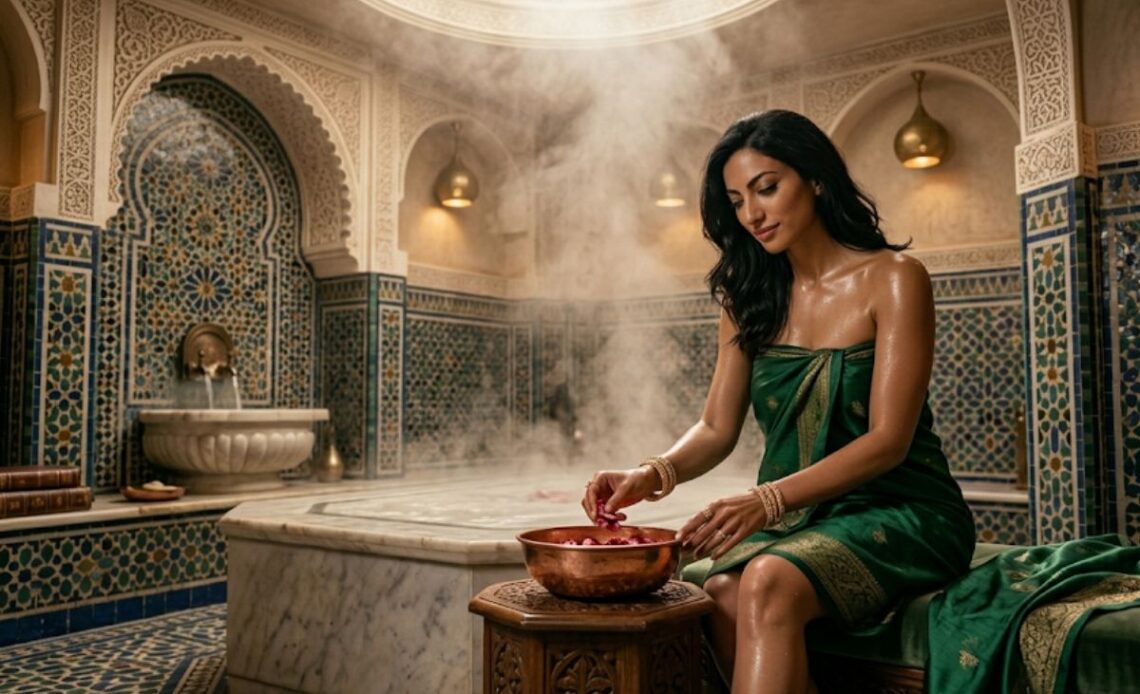
Now let us push open the door of the Hammam. Away from male gazes, the reality of Arab sensuality unfolds in an atmosphere of humid heat and sorority. Here, charm is no longer a concept; it is a tactile, almost sacred practice. However, it is vital to note that while the hammam is central to the Maghreb and the Levant, this culture of beauty is shaped by a mosaic of rituals varying from Yemeni incense to Gulf body oils. Women pass down ancestral beauty secrets that transform the body into a silken surface. Black soap to purify, the kessa glove to stimulate circulation, and above all, argan oil and rose water to satin the skin. This is not a superficial beauty; it is a ritual preparation for the caress, a celebration of the flesh for its own sake.
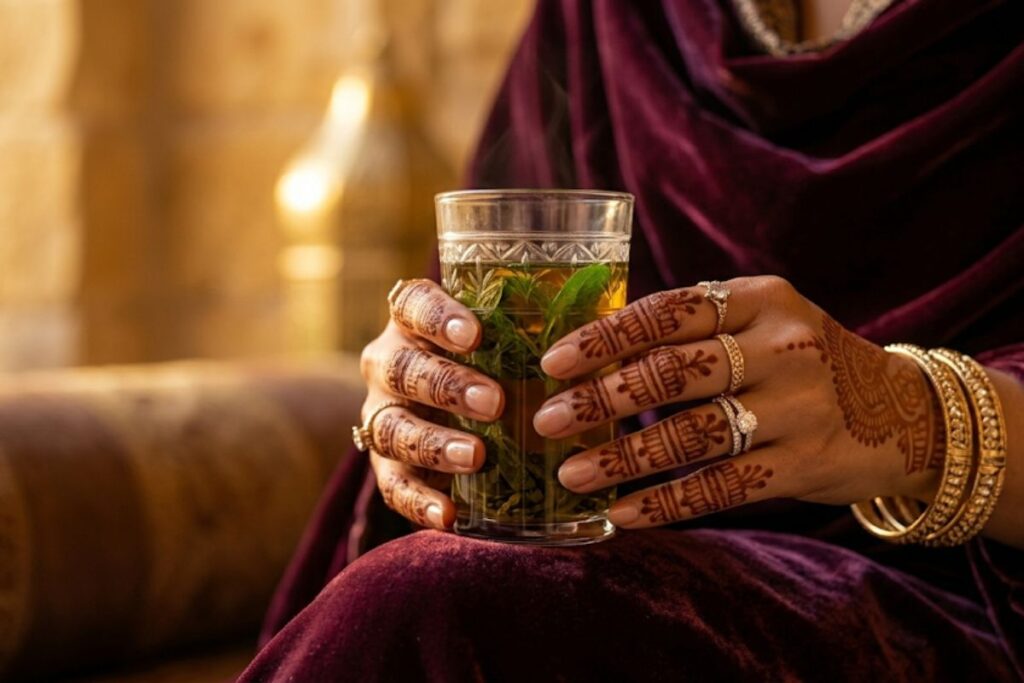
This approach to beauty is holistic: it engages all the senses. The scent of orange blossom permeating the hair, the softness of a honey scrub, the coolness of henna… Each gesture is an ode to voluptuousness. The Arab woman does not simply « put on makeup »; she adorns herself, she prepares as one prepares for a celebration. This sensuality, experienced in the intimacy of the baths, then diffuses outward, invisible yet palpable, in the way she moves, sits, or lets a bracelet slide on her wrist. Fantasy here meets physical reality: that of skin worked to be a permanent invitation to touch.
The Unsubmissive Muse: The Elegance of Emancipation
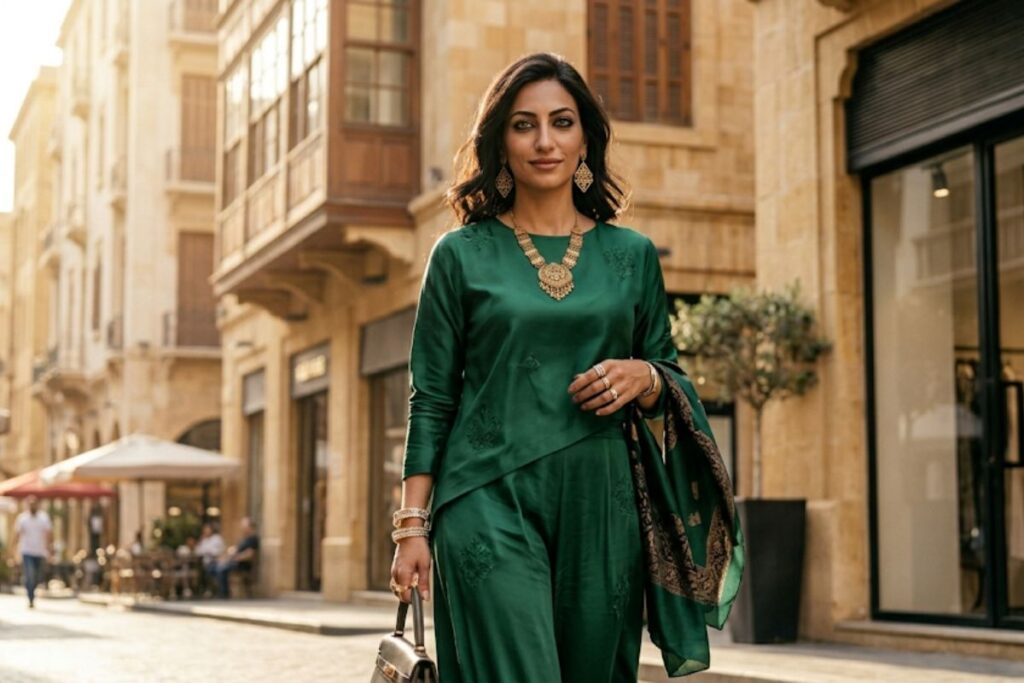
However, limiting the Arab woman to her beauty rituals or her smoldering gaze would be a fundamental mistake. The reality today is that of a woman who has taken back the reins of her own mystery. Whether in Beirut, Dubai, or Paris, the contemporary Arab woman plays with her codes. She is no longer the captive of the harem, but an unsubmissive muse who uses seduction as a tool of emancipation. She knows her cultural heritage is an erotic treasure, and she chooses to reveal or conceal it according to her own desire. Mystery is no longer a cage imposed by society, but an adornment chosen to assert her freedom.
This new face of Oriental femininity shatters the clichés of submission. We discover powerful and active women in the fields of art, science, or politics, whose charm lies precisely in this contrast between a thousand-year-old tradition (a taste for rare perfumes, the elegance of draping) and a striking modernity. Their desire is no longer passive; it is a force expressed in creation, intellect, and an assumed sensuality that no longer asks for permission. The true mystery, ultimately, is not in what is hidden by the fabric, but in the complexity of these women who navigate between multiple worlds with infinite grace.
So, the mysterious charm of Arab women, fantasy or reality? The answer lies in the alchemy between the two. Fantasy opened the door of the imagination, but reality, made of ancestral rituals, a culture of the gaze, a sophisticated literary tradition, and a flamboyant emancipation, is far more vibrant than any Orientalist painting.
This charm is not a myth; it is an education of desire, a way of inhabiting one’s body with a keen awareness of its power of fascination. The mystery does not evaporate with knowledge; it transforms into a deep admiration for those who, with a single glance underlined in black, continue to make the heart of the world beat. The journey is only just beginning.