


Thehistory of feminine beauty is not a long, quiet river, but rather a succession of cycles and ruptures. If the 1920s advocated an androgynous silhouette, the advent of cinema and popular culture quickly reversed the trend, establishing voluptuous forms as the absolute ideal. Yet, beyond mere aesthetics, these generous silhouettes were often worn by women of character who were able to transform their curves into veritable symbols of power.
Icons such as Marilyn Monroe and Sophia Loren not only left their mark on their era through their physique, but also redefined the standards of modern femininity. Subsequently, contemporary figures have taken up the baton to challenge the dictatorship of extreme thinness. This article explores the careers of these ” hourglass ” ambassadors and shows how they imposed a fulfilling vision of the female body.
Hollywood’s Golden Age: the advent of the “Latin Bomb” and the Pin-up girl
Thepost-war years marked a radical shift infeminine aesthetics. After hardship, the world was thirsty for abundance, and this was reflected in the triumph of the hourglass figure.
Marilyn Monroe
She was the figurehead of this movement. Much more than just an actress, she created a balance between touching vulnerability and iconic shapes. By imposing her curves as the absolute standard of the ’50s, she proved that sensuality was not incompatible with a certain softness, making her generous breasts the center of gravity of a glamour both candid and incendiary.
Sophia Loren and Gina Lollobrigida
At the same time,Europe was exporting a new kind of magnetism with ” Mediterranean chic “. Italian icons such as Sophia Loren and Gina Lollobrigida shook up Hollywood codes that were sometimes too smooth. They brought a more “earthy ” and natural dimension to the buxom silhouette. For them, generous breasts are not an artifice, but the symbol of overflowing vitality and sovereign femininity, rooted in reality. They impose the idea that the female body can be both sculptural and profoundly human.
Jayne Mansfield
Finally, in a more provocative vein, Jayne Mansfield tookextravagance to the extreme. Aware of the power of her image, she turned her bust into a genuine marketing argument and political communication tool. By playing with vertiginous necklines, she opened the way to a strategic use of shapes, transforming the ” pin-up ” into a show figure capable of capturing the world’s attention with a single glance.
Vintage transition: between burlesque and resistance
If the ’50s set the hourglass standard, the following decades saw the emergence of icons who used their ample bosoms not just as an ideal of beauty, **but** as a veritable weapon of self-assertion and subversion.
Brigitte Bardot
Brigitte Bardot was the first to embody this breakthrough. In France, and then the world over, she imposed the myth of the ” BB “: a wild, almost carefree sensuality, where the plunging bust was married to a childish pout. Far from the staid sophistication of Hollywood, Bardot naturalized generous forms. She took them out of evening gowns and put them in bikinis on the beaches of Saint-Tropez, creating an aesthetic of freedom that left a lasting mark on 60s fashion.
Dolly Parton
On the other hand, Dolly Parton chose a radically opposite path: that ofassertive artifice. More than a country star, she became a cultural icon by transforming her figure into a hyper-feminine cartoon character. With a wry sense of humor, she often declared: “It takes a lot of money to look this cheap”. By exaggerating her features and bosom, she regained control over the gaze of others. For Dolly, a generous body is not a biological inevitability, but an artistic construction and a tool of power that has enabled her to build a veritable empire.
The modern era: the return of ” Curvy ” and the influence of social networks
The passage to the 21st century has marked a mutation: the generous bust is no longer just a cinematic ideal, it has become a global pop culture phenomenon, amplified by thedigital image.
Pamela Anderson
Pamela Anderson set the ball rolling in the 90s. By becoming theglobal icon of Baywatch, she defined an athletic yet hyper-voluptuous aesthetic. Between the cult of the perfect body and the assertive use of plastic surgery, she showed that the figure could be sculpted to suit a glossy imagination, becoming the pin-up of the MTV era.
Monica Bellucci
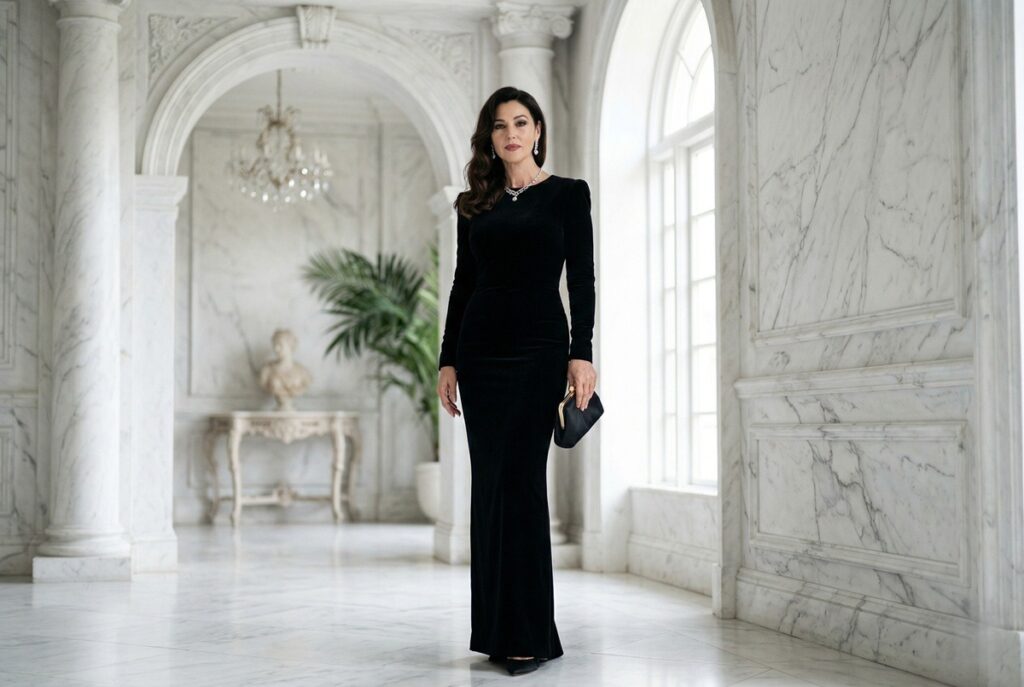
However, a more natural reaction came from figures like Monica Bellucci. The Italian actress rehabilitated a timeless sensuality, refusing to bow to the diktats of extreme slimness on the catwalks. She proved that full curves were synonymous withabsolute elegance and assumed maturity, offering a sophisticated alternative to teenage fashion standards.
Kim Kardashian and Christina Hendricks
Finally, the arrival of social networks radically changed the game with Kim Kardashian and Christina Hendricks. While the former has built an empire by breaking the codes of slimness to impose an extreme “hourglass” silhouette (often described as *belfie-ready*), the latter, through her role in the series *Mad Men*, has caused a veritable cultural earthquake. As Joan Holloway, Christina Hendricks reminded the world that opulent breasts were the height of retro-modern chic. Together, they contributed to the “Body Positivity” movement, where generous forms are no longer concealed, but proudly displayed as a standard of self-confidence.
Sociological analysis: what it says about the times
The changing perception of generous breasts is not just a question of fashion; it mirrors the tensions between control and freedom of the female body.
Emancipation through image
For a long time, generous curves were synonymous with apassive object of desire. But modern icons have reversed this trend. By assuming and even exaggerating their curves, women like Dolly Parton and Kim Kardashian have regained control of their own “narrative”. No longer subject to the male gaze, they direct and monetize it, transforming their silhouette into a tool of financial and political independence.
The Body Positivity debate
Today, the celebration of buxom figures is part of a broader movement of self-acceptance. Yet the question remains: is this a real liberation or a new straitjacket? While the ” size zero ” standard is receding, it is sometimes replaced by an injunction to the “perfect hourglass figure”, often difficult to achieve without medical help or digital retouching. It’s essential to distinguish this phenomenon from the original *Body Positivity* movement, which advocates acceptance of all bodies, including those that don’t fit this voluptuous new norm.
Influence on haute couture
Historically, high-end fashion has often favored very slim, “supportive” bodies, so as not to obscure the cut of the garments. The influence of these icons forced designers to adapt. Jean-Paul Gaultier’s famous cone bra for Madonna comes to mind, transforming the bosom into a conquering suit of armor, proving that shapes can be the driving force behind the most cutting-edge stylistic creation.
From Marilyn to Christina Hendricks, generous figures have travelled a complex path, oscillating between Hollywood fantasy and self-affirmation. These women didn’t just “show off” their curves; they embodied a self-confidence that shook up the codes of each decade. Today, as bodily diversity becomes a central value, the generous bust is no longer an exotic exception, but one of the many expressions of a plural and uninhibited femininity.