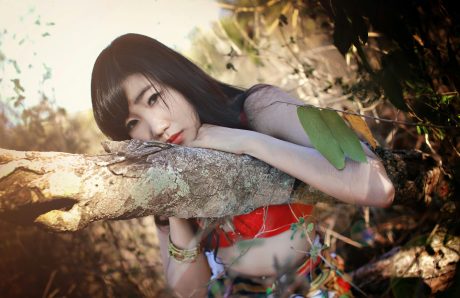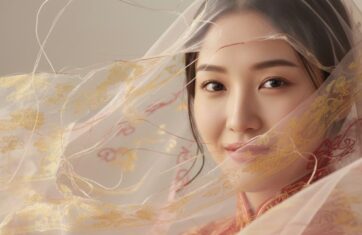



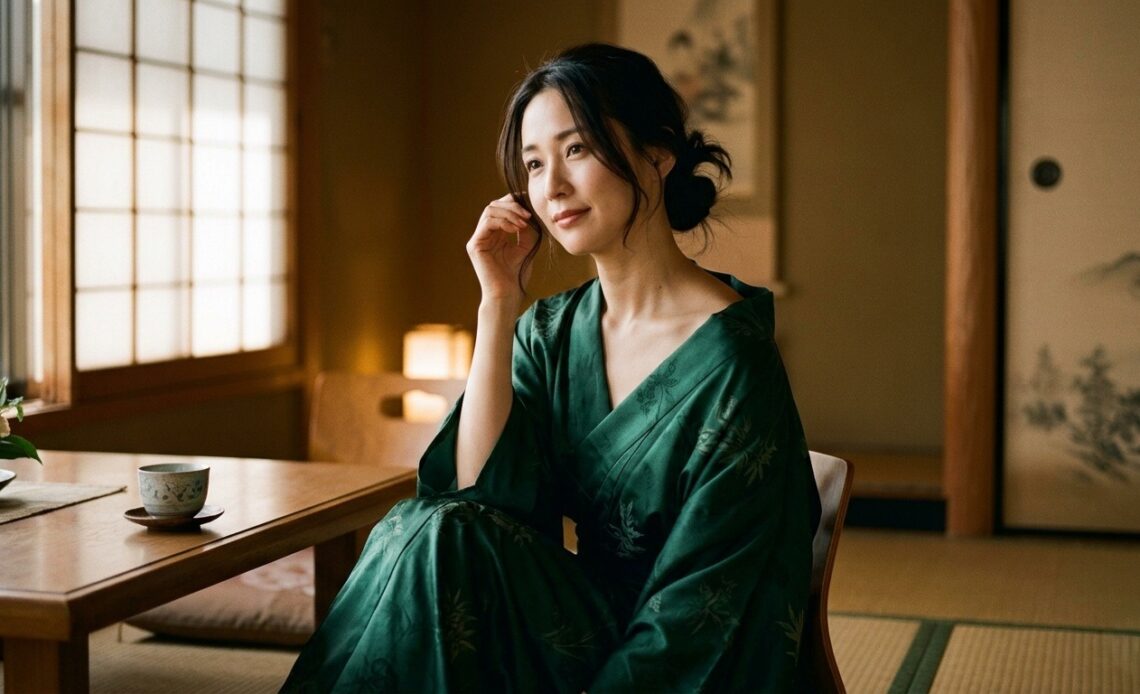
When we think of the Orient, our gaze often wanders to the reflections of an imaginary mother-of-pearl. The Asian woman has long been depicted as a creature of mist, a porcelain silhouette whose pale, moon-like skin seemed to exist only to be touched by the fantasy of the Other. But behind this silken curtain, a more vibrant, carnal and sometimes darker truth has always beaten the drum, often obscured by Western prisms that struggle to grasp the multiplicity of Asian cultures. Today, this image no longer allows itself to be captured: it escapes the old frames to impose its own light, a raw clarity that defies centuries of silence and submission.
The weight of archetypes
For decades, the Western imagination has confined Asian women to an almost hypnotic duality. On the one hand, the “Lotus Blossom”, the fragile flower whose submissive perfume intoxicated colonial narratives, frozen in iconic works such as Madame Butterfly; on the other, the “Dragon Lady”, the predator with jade venom, as desirable as she was forbidden. These figures were not flesh-and-blood beings, but mirrors in which the West projected its own thirst for conquest and unspoken fears. Asian women were loved like rare objects: for their immobility, for their silence, for the exotic distance that made them malleable to male desire.
This fascination was not innocent. It was the fruit of a “Male Gaze” that transformed otherness into eroticism. In the dark recesses of cinema and literature, the Asian woman became a label, a satin suit to be slipped on to satisfy a quest for the exotic. This view, which still persists in the streets of our metropolises, reduces a complex identity to a smooth surface, a porcelain doll with no soul of its own, condemned to being no more than a backdrop for someone else’s fantasy.
The awakening of the muses
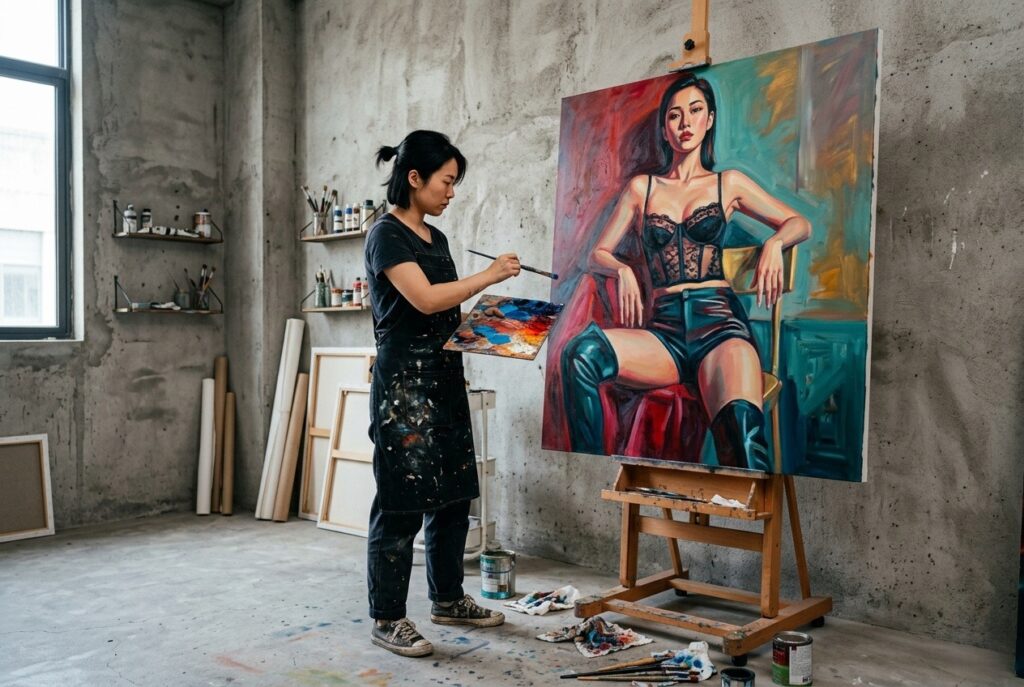
Beneath the surface of oils and inks, a muted revolution began to rumble. At the dawn of the twentieth century, Chinese artists in particular began to regain possession of their own bodies. They no longer wanted to be the passive model to be contemplated, but the hand holding the brush. By painting themselves, capturing their own melancholy and inner strengths, they broke the mirror of imposed canons. Self-portraiture became an act of sensual sedition, a way of saying: “This is who I am when no one is looking”.
This liberation found a powerful echo on silver screens. East and Southeast Asian cinema has finally traded in the figure of the maudlin victim for that of the indomitable avenger, whether in Hong Kong’s *wuxia pian* or South Korea’s thrillers. Women are no longer seen for their vulnerability, but for their telluric power. In genre films, she becomes a vengeful specter or a warrior whose every move is a deadly dance. Desire then changes sides: it’s no longer a question of possessing, but of being subjugated by a force that surpasses us. Here, beauty no longer reassures, but worries and fascinates with its savage depth.
Flesh and voice: rediscovering identity
Today, in the tumult of cities and the flux of networks, a new generation of women refuses the uniform of fantasy. Emerging from the diaspora and often in dialogue with their counterparts on the continent, they carry within them multiple heritages, skins that have known several suns. They are no longer monolithic blocks, but fluid, plural identities that claim their right to the ordinary as well as the extraordinary. They reject this “museum beauty” to embrace a cruder, more human reality, where imperfections are marks of freedom.
This quest for self also involves a reappropriation of the body in the face of global beauty standards. Between digital filters and the pressure of tradition, contemporary Asian women navigate a sea of paradoxes. But it is precisely in this tension that a new desire is born: that of vibrant authenticity. Fascination no longer lies in obeying codes, but in the ability to subvert them, to make one’s own skin the territory of an intimate revolution. We no longer seek to please the Other, but to please ourselves, in a sensual celebration of our own existence.
The dawn of a new look
The image of the Asian woman is no longer that of a distant island observed through a spyglass. She has become a land of fire and ice, a territory of pure creation that continues to haunt us, no longer by its submissiveness, but by its insolent autonomy. By breaking the chains of silk, she invites us to a new kind of desire: that born of the encounter between two equal freedoms. The journey has only just begun, and it promises to be as fiery as it is necessary, especially in the fight against the intersection of oppressions and the faithful representation of all Asians.