


In a world where geographical borders are becoming increasingly blurred, mixed marriages are no longer the exception, but the norm. According to recent sociological studies, the number of cross-cultural marriages has exploded over the last two decades, testifying to a growing openness in attitudes. At the heart of this emerging mosaic are partnerships involving an Arab woman, whose union represents a unique bridge between two worlds.
These relationships, which unite a woman from a culture rich in community and family values with a partner of another nationality, are incomparably complex and beautiful. They are the theater where values, languages and traditions are negotiated on a daily basis. The question is, how do these couples navigate cultural challenges, family expectations and social judgments, and still manage to build a rich, solid and fulfilling relationship?
To answer this question, we will first explore the main obstacles encountered, before highlighting the immense cultural wealth they generate. Finally, we’ll draw on current trends to illustrate the resilience and success of these intercultural unions.
The cultural framework and its pillars
Marrying an Arab woman, whether from the Maghreb, the Levant or the Gulf, means embracing a deep and sometimes demanding cultural heritage. For the couple to flourish, the non-Arab partner must understand and respect the pillars of this culture. These foundations are not stereotypes, but sociological realities that influence everyday life and decisions.
The first element, and often the most decisive, is the central role of the family. In Arab culture, the approval of parents, especially the mother, is paramount, even for a modern, independent woman. Traditions and festivals, such as Ramadan, Eid and weddings, become unavoidable events and moments of negotiation within the couple. While these family ties may seem invasive at first, they are also a precious social and emotional safety net.
The delicate question of religion
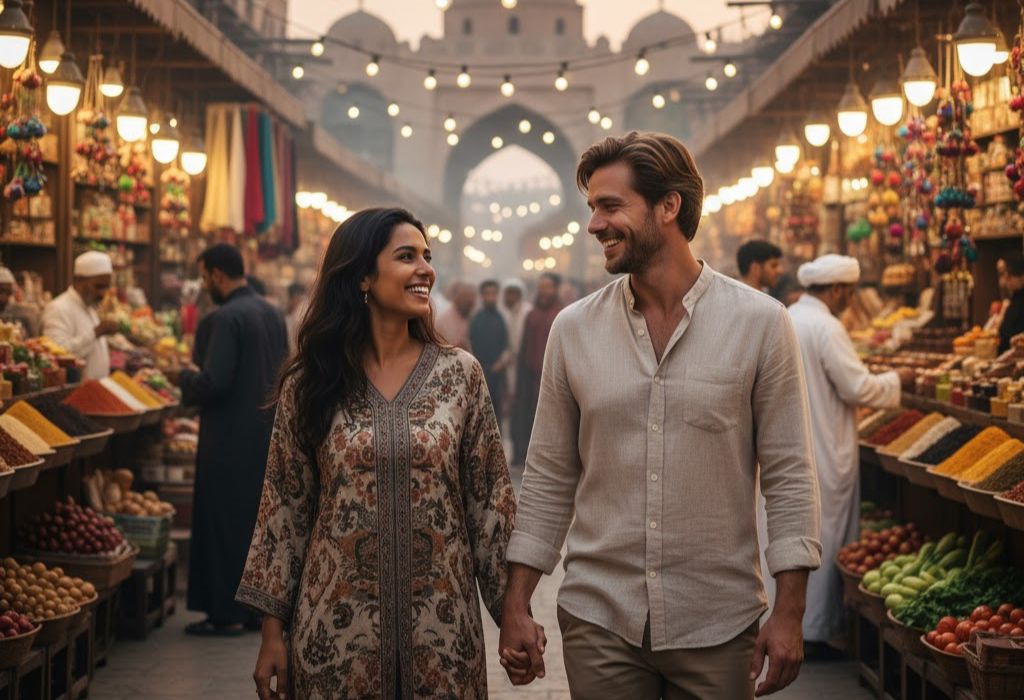
Inter-religious marriage represents one of the most delicate challenges. Whether Muslim, Christian, Orthodox or other, religion often has a direct impact on the Arab woman’s identity and on the upbringing of her future children. While some families are very liberal, others will require conversion or, at the very least, a formal commitment to the offspring’s faith. Managing this divergence requires open dialogue, mutual tolerance and the ability to define together the boundaries and spiritual practices of the home.
Moreover, the couple must reconcile different approaches to communication and roles. While the modern Arab woman may aspire to perfect equality, the family dynamics of her childhood are sometimes based on more traditional gender roles. This can create tensions around public expression, affection, financial management or the division of domestic tasks. Appropriate love language and a compromise between inherited values and the modern vision of their home are essential to their harmony.
The challenges of everyday life: between external scrutiny and internal friction
Living intercultural love means accepting that the couple is not just a union between two individuals, but a combination of two value systems. Daily frictions are inevitable, but they are also the driving force behind a stronger relationship, provided they are approached with kindness and maturity.
One of the most difficult obstacles for these couples is undoubtedly the outside world. Whether it’s benevolent prejudice or ordinary racism (often directed at the non-Arab partner, seen as “stealing” the woman from his culture, or at the Arab woman, suspiciously seen as “emancipated”), social pressure is omnipresent. This pressure can lead to feelings of isolation or misunderstanding, requiring great strength of character from both partners.
Internal family pressure adds another layer of complexity. The couple often has to contend with the preconceived notions of relatives, who fear that the union will dilute the family’s cultural or religious identity. These difficulties manifest themselves in inappropriate comments, reluctance to accept the partner or even attempts to destabilize the household. These situations require the couple to be able to deal with the emotions of their respective families without letting this undermine their own relationship.
Cultural richness: broadening horizons
Despite external obstacles and inevitable cultural frictions, intercultural couples between a Western partner and an Arab woman are invaluable sources of personal enrichment.
Commitment to an intercultural union forces both partners to develop a profound openness and empathy. Every disagreement or misunderstanding becomes a life lesson that leads to a better understanding of the world, beyond borders and media. The non-Arab partner learns the patience and subtlety of family dynamics, while the Arab woman can explore a different freedom and way of life. This mutual process forges a tolerance and resilience that benefits all aspects of the couple’s life.
One of the greatest pleasures of these unions is the sharing of celebrations and traditions. The home becomes a place where Christmas lights rub shoulders with Ramadan dates, where family gatherings celebrate both Eid and the Western New Year. The couple doesn’t just coexist; they merge rituals to create unique couple traditions. It is in this synthesis that the real richness lies: children, in particular, benefit from this dual heritage, becoming naturally bilingual and bicultural citizens of the world.

Trends and the future of intercultural couples
The history of mixed couples is not static; it is evolving with globalization and the Arab diaspora. Today, these unions are gradually moving from being the exception to the norm in many urban contexts.
The normalization of intercultural unions is largely facilitated by social networks. Platforms like YouTube and Instagram are full of couples documenting their daily lives, downplaying challenges and showing love beyond differences. This visibility helps to break down stereotypes and provide positive role models for new generations.
What’s more, changing demographics, including waves of immigration and diaspora settlement in the West, naturally create more opportunities for encounters. These geographical trends confirm that diversity is a sustainable and growing social reality.
Tips for a successful intercultural couple
The success of an intercultural couple does not depend on chance, but on the implementation of a few fundamental pillars:
- Communication: Never let a cultural difference turn into a personal misunderstanding. Constant, sincere dialogue is the key.
- Curiosity: Approach your partner’s customs not as constraints, but as fascinating windows on the world.
- Compromise: Find the “third way” unique to the couple, without ever demanding total abandonment of the other’s identity.
Intercultural couples with an Arab woman are veritable social laboratories. They are a driving force for integration and living proof that to love is to choose mutual enrichment over uniformity. The challenges are real, but the dual cultural richness that emerges is a priceless legacy, forging more open individuals and a more connected world.