


In Western circles, Arab femininity is increasingly analyzed in ways that are the antithesis of stereotypical images. And with good reason, numerous figures from this community are emerging, with as many differences as profiles. It is said that Arab women have a marked presence in this new world, while still clinging to symbolic elements of their ancestral heritage. But, in concrete terms, what characterizes the Arab woman today? In this article, we take a closer look.
Femininity in the plural
It’s simplistic and misleading to think of Arab women in their entirety as having the same identity, the same culture and the same attributes. In reality, there is a vast contrast between a woman rooted in tradition in Casablanca, a businesswoman in Dubai and an academic in Algiers. This is largely due to geographical distance, social realities and each woman’s capacity for self-determination. Nevertheless, certain characteristics and values bring them closer together.
The supposed differences between coquetry and Haya
In the Arab world, the term Haya refers to a certain moral elegance and modesty. Some people oppose it to coquetry, but in reality today, they are complementary. Clearly, modesty does not mean a lack of seductive flair: Haya invites women to reveal themselves at the right pace. Femininity is revealed in the fact of suggesting, of speaking well, of handling one’s body well, beyond being physically beautiful or not.
Undeniable inner strength
It seems essential to highlight the inner strength of the Arab woman. This is in contrast to certain stereotypes that give her a secondary role in the Arab world. Indeed, women have always occupied a strategic position in Arab society. In public, she takes a back seat, and in private, she’s the foundation of the family. She transmits, advises and shares her opinion on key issues. For several decades now, Arab women have been projecting this influence outside the family cocoon (in economic, artistic and social circles, etc.). This shows that Arab femininity is not static, but adapts to the times in which it lives.
The persistence of aesthetic rituals
Beyond its moral and symbolic aspects, Arab femininity also takes the form of physical habits and attitudes. Some of these have been observed for millennia. It’s a veritable ode to dexterity.
The hammam as a place of conviviality
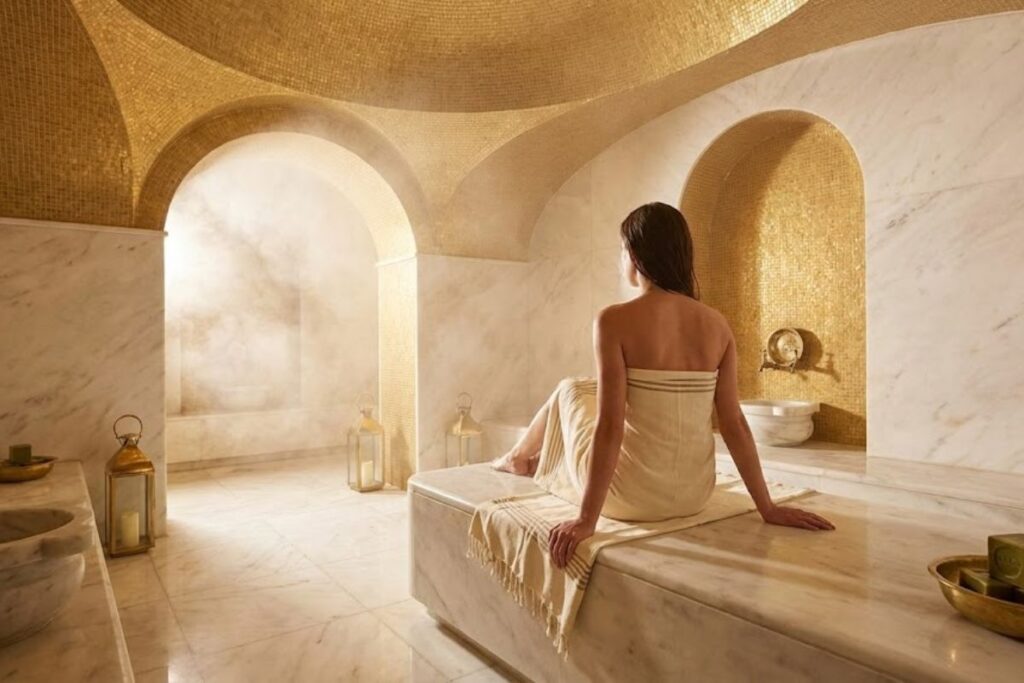
For Arab women, going to the hammam is much more than a beauty treatment. It’s a place where the stresses of everyday life are forgotten, a return to their roots. The body is celebrated in an atmosphere of marble and steam. Better still, it’s in this space that the spoken word is completely liberated. Between a kessa glove and a bar of soap, confidences, both heavy and light, are made. In the enveloping warmth of the hammam, bodies relax, skin heats up, senses sharpen. The water slowly glides by, fragrances intensify and breathing becomes deeper. This ancestral ritual reveals an intimate relationship with the body, far from the male gaze, but paradoxically charged with raw sensuality. What takes place is not shown, and it is precisely this secrecy that fuels the fantasy.
The interplay of materials: Perfumes, Incense and Oils
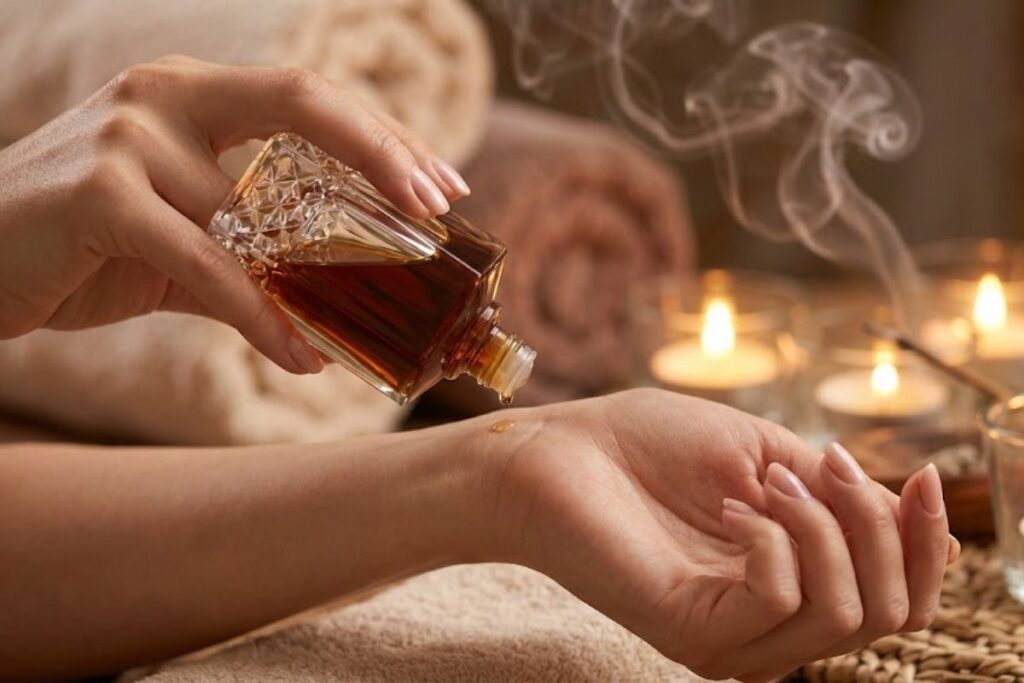
When we speak of Arab aesthetics, we’re also referring to a powerful style of scent. Indeed, perfume occupies a central place in society. It’s not just a question of spraying fragrance, it’s about layering. This technique involves superimposing several layers of specific cosmetic products, such as oils, incense and perfumes. In this culture, fragrance acts as an invisible signature. It precedes the body, lingers after the passage, imprints itself on the memory. An oriental fragrance doesn’t just seduce: it invades, envelops and confuses. For many, it becomes an immediate trigger of desire, capable of reviving a memory, an imagined scene, or a fantasized presence long after it has disappeared.
Modern codes of Arab femininity
In today’s 21ᵉ century, the Arab woman has found the happy medium between emancipation and her original self-effacement. In concrete terms, she is revealing herself a little more to the world, with her values and particularities. Her roots are celebrated, in a no-holds-barred way, far removed from the Western way of thinking.
Modest fashion” as a physical and political statement
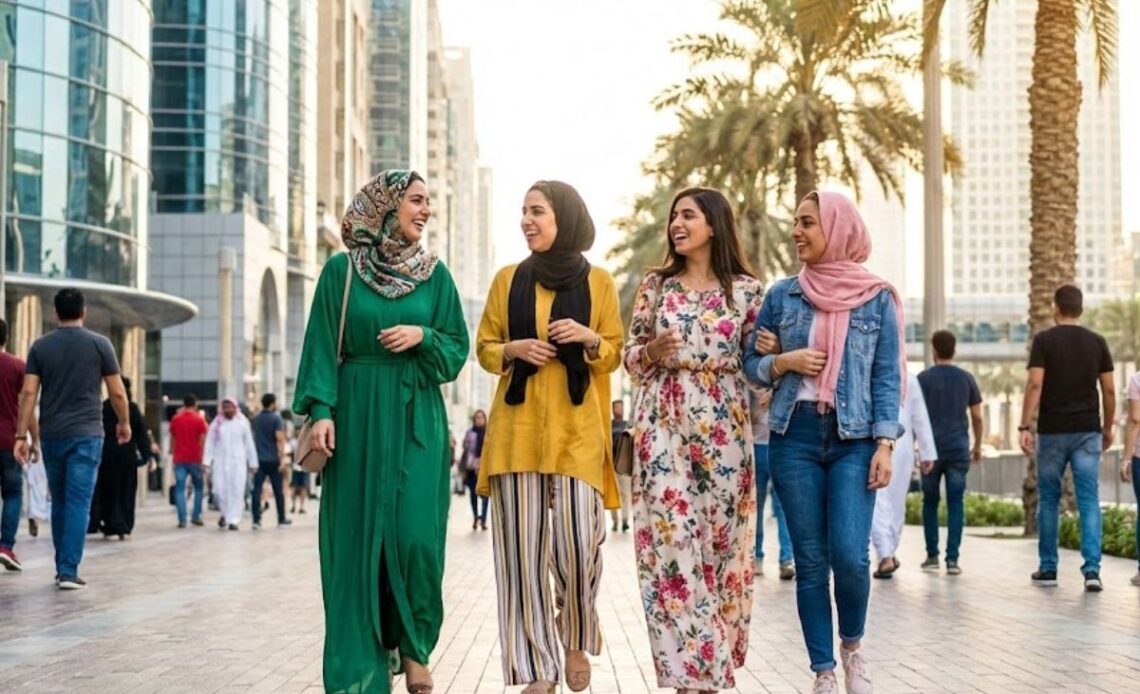
Modest fashion is one of the most important ways in which Arab women are asserting their identity. How does it manifest itself? Arab (female) opinion leaders are adapting Western creations to local tastes, making them more in tune with their own. For example, the veil, perceived as an object of submission in the West, is becoming an assertive choice of style. The same is true of loose-fitting garments, whose stylistic markers of distinction are found in cut, color and texture. This new situation has prompted leading fashion designers to upgrade their collections. They now see Arab women as a real market.
The influence of social networks and assertive female leadership
Social networks are an enormous lever for the affirmation of Arab femininity. From Cairo to Baghdad, women find in TikTok, Facebook, Instagram and many other social networks the means to unveil a version of themselves different from the clichés of the news channels. Artists, scientists and businesswomen are all showcasing their everyday lives. It shows that it’s possible to be an Arab woman and still be a careerist or a social network star.
What’s more, the Internet has made it possible to extend the “women in the hammam” concept to an international level. In fact, Arab women who are the most knowledgeable on specific subjects can exchange ideas and give advice to others, wherever they may be. These may include psychological advice, entrepreneurial guidance, beauty tips and more.
In conclusion, to speak of Arab femininity is to recognize a rich and plural identity. Far from being uniform, it is forged in a dynamic balance between loyalty to ancestral traditions and a desire for modern emancipation. Strong in her values, the Arab woman of today, unique and uninhibited, is not out to conquer the world, but in search of recognition and legitimacy. It is therefore essential to appreciate her in all her complexity, without prejudiced vision or desire for hasty change.